
The oldest written account of the tiyanak does not describe a monster.
In 1589, Franciscan missionary Juan de Plasencia listed the spirits feared by Tagalogs. One was the patianac. If a woman died in childbirth, he wrote, people believed she and her child were punished, and at night she could be heard lamenting.
Plasencia believed Christian preaching had already wiped out the belief. Four centuries of Filipino folklore suggest otherwise.
What Is a Tiyanak?
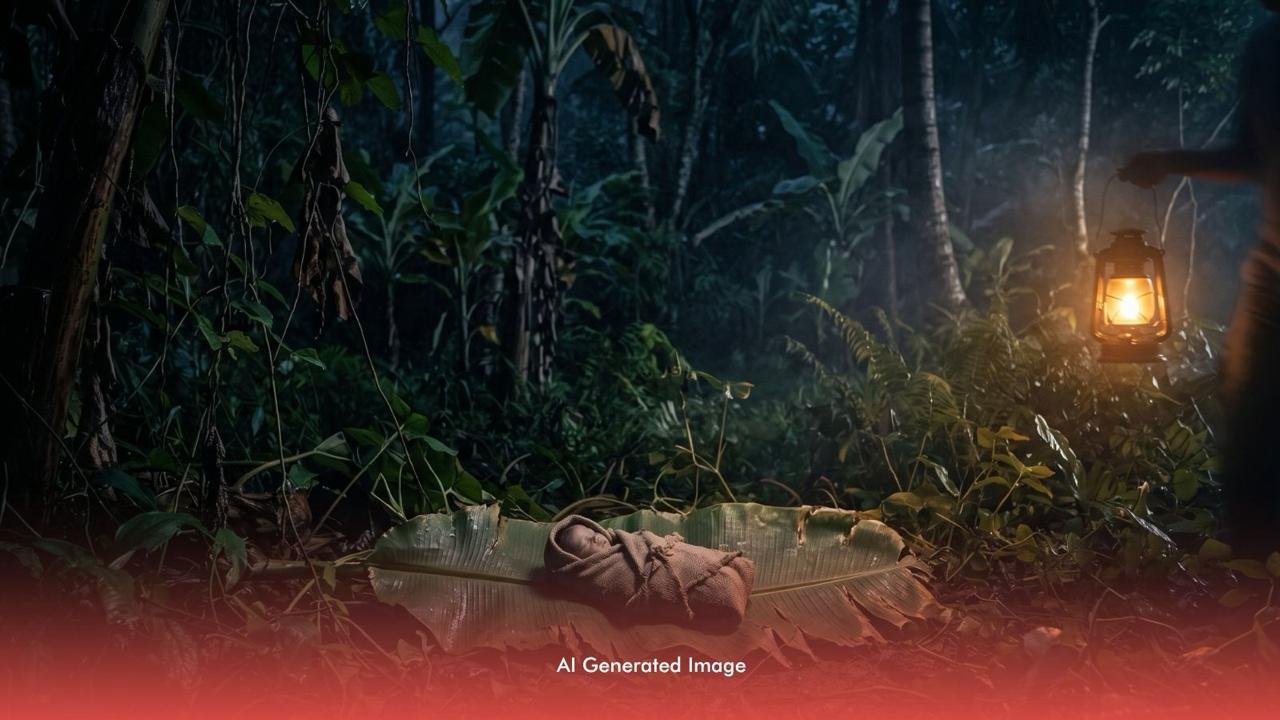
In modern Philippine folklore, a tiyanak is a creature that takes the form of a newborn baby and cries in lonely places such as forests, fields, roadsides, and swamps to lure people closer.
Once someone picks it up, the “baby” reveals its true nature.
The name varies across regions, including tiyanak, tianak, patianak, and muntianak. So does what happens next. In different stories, the creature bites, drains a woman who tries to nurse it, leads people astray, carries off children, flies away, or transforms into a bird.
The fear works because the bait is helplessness itself. Hearing a baby cry in the dark naturally makes people want to help. In tiyanak stories, that kindness is exactly what gets the victim into trouble.
What Does a Tiyanak Look Like?
At first, it looks like an ordinary infant. Then something changes.
Folklorist Maximo Ramos recorded a story about two boys who found a plump newborn lying on a banana leaf. After they held and kissed it, the baby transformed into a tiny, wrinkled old man with a long beard and mustache, a flat nose and enormous eyes. One leg was shorter than the other, forcing it to move in leaps.
That strange old-man-in-a-baby’s-body image is not new. In 1763, friar Antonio Mozo described the patianac as a being that “resembles a pigmy.” Ramos classified the tianak among the dwarfs of Philippine folklore rather than the flesh-eating monsters of later horror stories.
Other accounts describe sharp nails, bird-like cries, unusually long ears or goat-like hooves. Modern movies often combine several of these traits into the familiar fanged and clawed baby.
Where Is the Tiyanak Found?
Collected stories place the tiyanak mainly in Tagalog and Kapampangan communities, including areas around Malolos, Malabon, Batangas, Mindoro, and Pampanga.
The belief also appears in parts of Mindanao. Among the Mandaya, one account describes the patianak as the spirit of a child whose mother died while pregnant.
The details change from one community to another, but the central idea remains the same: a child who died before having the chance to live becomes something that lingers between the human and spirit worlds.
Why Is the Tiyanak Dangerous?
Older accounts connect the creature to one of the most dangerous moments in a woman's life: childbirth.
Around 1731, Augustinian friar Tomás Ortiz wrote that Tagalogs blamed the patianac for difficult or unsuccessful births. According to his account, the creature hid in a tree near the house of a woman in labor and sang.
Families had elaborate ways of driving it away. Men reportedly stripped naked, took up shields, bolos and lances, and stood on the roof ridge and beneath the house, striking at the air. Some families even moved the mother to another house.
Historian Joaquín Martínez de Zúñiga gave another version in 1803. He wrote that the creature could interfere with childbirth using a long, thin tongue that reached the womb. The husband was said to bar the doors, light a fire, and slash the air with a sword until the child was born.
Interestingly, the thread-thin tongue was not always associated with the tiyanak. In Ortiz's earlier account, the same feature was attributed to the usang, or aswang, before Zúñiga later connected it with the patianac.
Over time, Christian beliefs added another explanation. Tiyanak were increasingly described as the souls of children who died without being baptized. Modern stories, including Trese, have expanded the idea to include abandoned and aborted babies.
Where Did the Tiyanak Belief Come From?
At its heart, the tiyanak legend is connected to a painful reality.
Childbirth was once far more dangerous, infant mortality was high, and families regularly experienced deaths that could not be explained medically. Plasencia's original account of the patianac was tied directly to a woman dying during childbirth and the belief that she continued to lament at night.
The story then changed as Christianity spread.
The old spirit became associated with the souls of unbaptized children, giving the legend a distinctly Catholic interpretation. More recent versions reflect modern fears and social issues, including abandonment, pregnancy loss and abortion.
Seen across centuries, the tiyanak changes shape but keeps the same emotional core: grief over a child who never got the chance to grow up.
Where Has the Tiyanak Appeared in Pop Culture?
The creature made one of its biggest appearances in Philippine cinema through Tiyanak, the 1988 Regal Films horror movie directed by Peque Gallaga and Lorenzo A. Reyes and starring Janice de Belen and Lotlot de Leon.
The film was shot in San Pablo, Laguna, and became a memorable entry in Filipino horror. Critics had different reactions, with writer Lav Diaz describing it as genuinely frightening, while historian Ambeth Ocampo later remembered it as so campy and funny that it became memorable for a different reason.
The tiyanak also entered the world of Trese. In the comics, its first major case is “Embrace of the Unwanted.” The 2021 Netflix adaptation presents the creature as an aborted child who haunts its mother and longs for love.
The old folklore had moved from the birthing house to the forest, then onto the big screen.
Legends of the Tiyanak
One Tagalog story tells of a newly married couple who discover a crying baby on a tree root. The wife insists on taking it with them and tries to nurse it. The creature bites her, and by the time her husband returns, she is dead. The “baby” then flies into the trees.
In Oriental Mindoro, another tale tells of a mother who has already buried three babies. She finds an infant near a banana plant that looks exactly like her last child. She nurses it, but the creature does not stop until she dies. It then transforms into a black bird and flies away.
Another story involves a boy named Bata who encounters a bright-eyed child while playing hide-and-seek under the moonlight. The stranger knows his name and offers him puto. The boy is later found clinging to a banana tree, unable to speak, and can only be brought home after a priest blesses him.
Then there is Vicente, who was gathering rattan on Mount Arayat when he encountered small, floating beings beckoning him to follow. He turned his clothes inside out, causing the creatures to disappear. When he returned to town, he discovered that two days had passed even though he thought he had been gone for only an hour.
The story reflects a recurring motif in Philippine folklore: lost time. Like some engkanto stories, the supernatural encounter does not just frighten the victim. It distorts their sense of time.
What Do Old Folks Say to Do?
- Turn your clothes inside out. This is one of the most commonly recorded ways of breaking the creature's spell.
- Make noise. In some communities, people used pots, cans, and shouting to scare supernatural creatures away and help locate someone who had disappeared.
- Be careful with unexplained cries. Folklore warns against blindly approaching a baby's cry in an isolated place.
- Protect the mother during childbirth. The historic rituals of fire, locked doors, and armed men reflected fears surrounding dangerous childbirth. Today, that means proper prenatal care and skilled medical assistance.
- Remember the grief behind the legend. Many tiyanak stories are rooted in miscarriage, stillbirth, infant death, and the loss of a mother. These are real family tragedies, not just horror material.
The tiyanak has changed dramatically since Plasencia first wrote about the patianac in 1589. What began as the spirit of a grieving mother and child eventually became a crying infant in the forest, a supernatural predator and, finally, a familiar figure in Philippine horror.
The monster may not be real.