
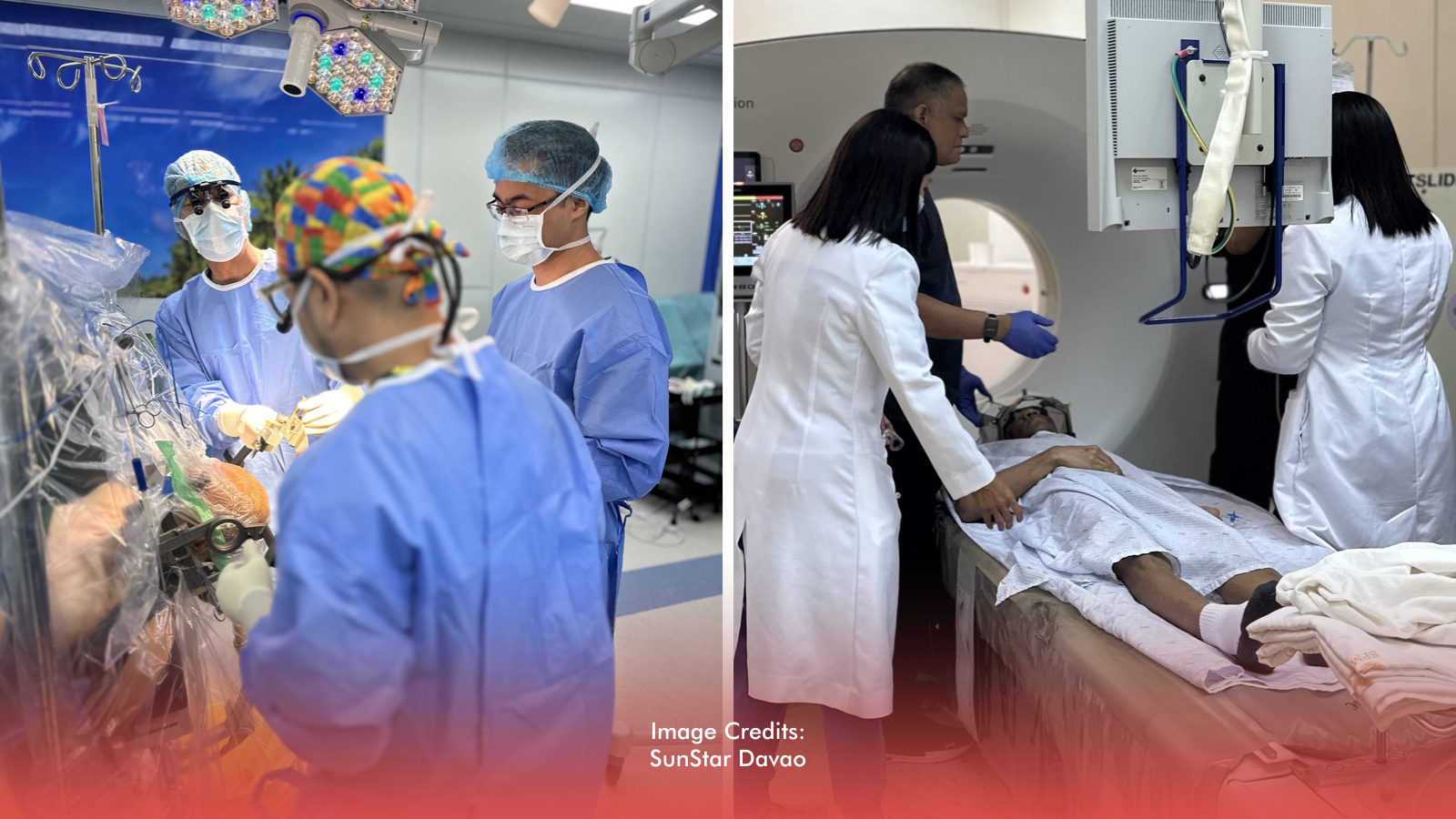
The government-run Southern Philippines Medical Center (SPMC) in Davao City has marked a major milestone in Philippine healthcare after successfully performing the country’s first adaptive sensing-enabled Deep Brain Stimulation (DBS) procedure.
The groundbreaking surgery was conducted on a patient diagnosed with X-linked dystonia-parkinsonism (XDP), also known as Lubag Disease, a rare inherited neurological disorder that mostly affects men with roots from Panay Island in the Visayas.
How the Advanced DBS Technology Works
According to Dr. Jose Nicanor P. Del Rosario, chair of the Institute of Neuroscience at SPMC, the hospital is the first in the Philippines capable of performing adaptive DBS using the latest technology developed by Medtronic.
He explained that the system works like a pacemaker for the brain, with electrodes implanted deep inside the brain and a generator implanted in the body.
“It’s like a wire that can generate electricity. We have a generator implanted here, and the electrode is placed deep inside the brain, so essentially it will fire as necessary, and it will last for 10 years,” Del Rosario said.
Experts from Cardinal Santos Medical Center in Metro Manila assisted the procedure in Davao. The surgical team included Dr. Jose Aguilar, Dr. Theodor Vesagas, Dr. Levi Maliwat, and Dr. Joselv Albano.
The Patient and Lubag Disease
The first patient was a 39-year-old nurse from South Cotabato who previously worked in Dubai. His symptoms began with abdominal contractions and progressed to severe dystonia about two years ago.
“It’s pretty advanced, he’s wheelchair-bound, and he’s in pain, losing significant weight. Basically, he is suffering,” Del Rosario said.
Lubag Disease is caused by a genetic mutation unique to people of Panay, passed through male lineage. Many residents of South Cotabato migrated from Panay, explaining the presence of cases in the province. The disease affects brain circuits controlling movement, causing twisting postures, stiffness, slowness, and shuffling gait.
A Big Leap for Philippine Neuroscience
Del Rosario said patients can become fully functional after DBS, allowing them to return to independent lives.
“If the procedure is successful, they can return to their normal lives,” he said.
He added that around 80 patients from Mindanao are scheduled to receive DBS at SPMC, as the hospital aims to expand access to the life-changing procedure for affected communities.
“The objective is for us to continue doing the procedure for our constituents because there is a large number,” he said.