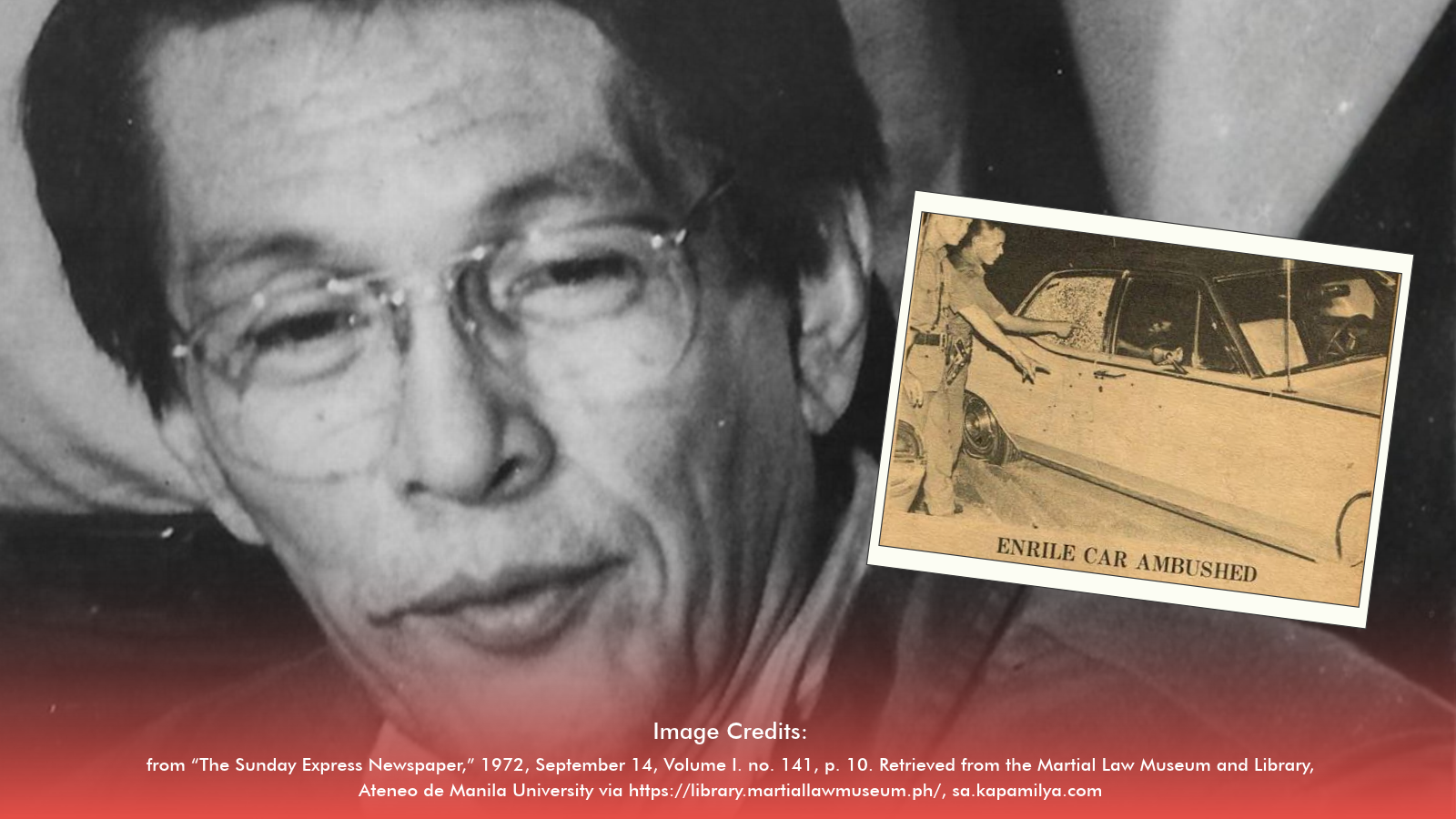
On September 22, 1972, the late former Defense Secretary Juan Ponce Enrile was reportedly attacked by gunmen while traveling through Wack Wack, Mandaluyong. The incident became one of the justifications cited by then President Ferdinand Marcos Sr. for declaring martial law. However, questions about whether the ambush was genuine emerged years later, particularly after Enrile himself admitted that it had been staged.
What Happened
According to Enrile’s account, his convoy was passing through the Wack Wack subdivision on its way home when a speeding vehicle overtook his escort car and fired several rounds at his vehicle. No one was reported injured in the attack, but the incident was used by Marcos as evidence of growing threats to national security.
On September 23, 1972, Marcos announced the implementation of martial law through Proclamation No. 1081, which he had signed two days earlier.
Enrile’s Reasoning
Following the 1986 People Power Revolution, Enrile broke away from Marcos alongside then Armed Forces Chief of Staff Fidel V. Ramos.
During a press conference on February 23, 1986, Enrile reportedly admitted that the ambush had been staged to provide a justification for martial law. Journalists who interviewed him, including Raymond Bonner and Sandra Burton, also documented his earlier admission.
Oscar Lopez, who lived near the reported ambush site, provided another account. In his 2000 book, he recalled that his driver witnessed people shooting at an empty car to make it appear as though it had been ambushed.
Why the Story Changed
In his 2012 memoir, Enrile denied staging the attack and called the accusation false. He maintained that the ambush was real and that political opponents had spread the story to discredit him.
However, historical research published by UP Diliman’s Marcos Regime Research project in 2022 revisited the conflicting accounts and examined the timeline of Marcos’ preparations for martial law. According to Marcos’ personal diary, he and his advisers had already agreed to set September 21, 1972, as the deadline for its implementation. This meant that preparations were underway before the reported ambush.
Later Impact
The controversy also remains relevant to how martial law is taught. A review by the FEU Public Policy Center found that only two of seven textbooks discussing the ambush identified it as “fake,” while the others didn’t question its authenticity.