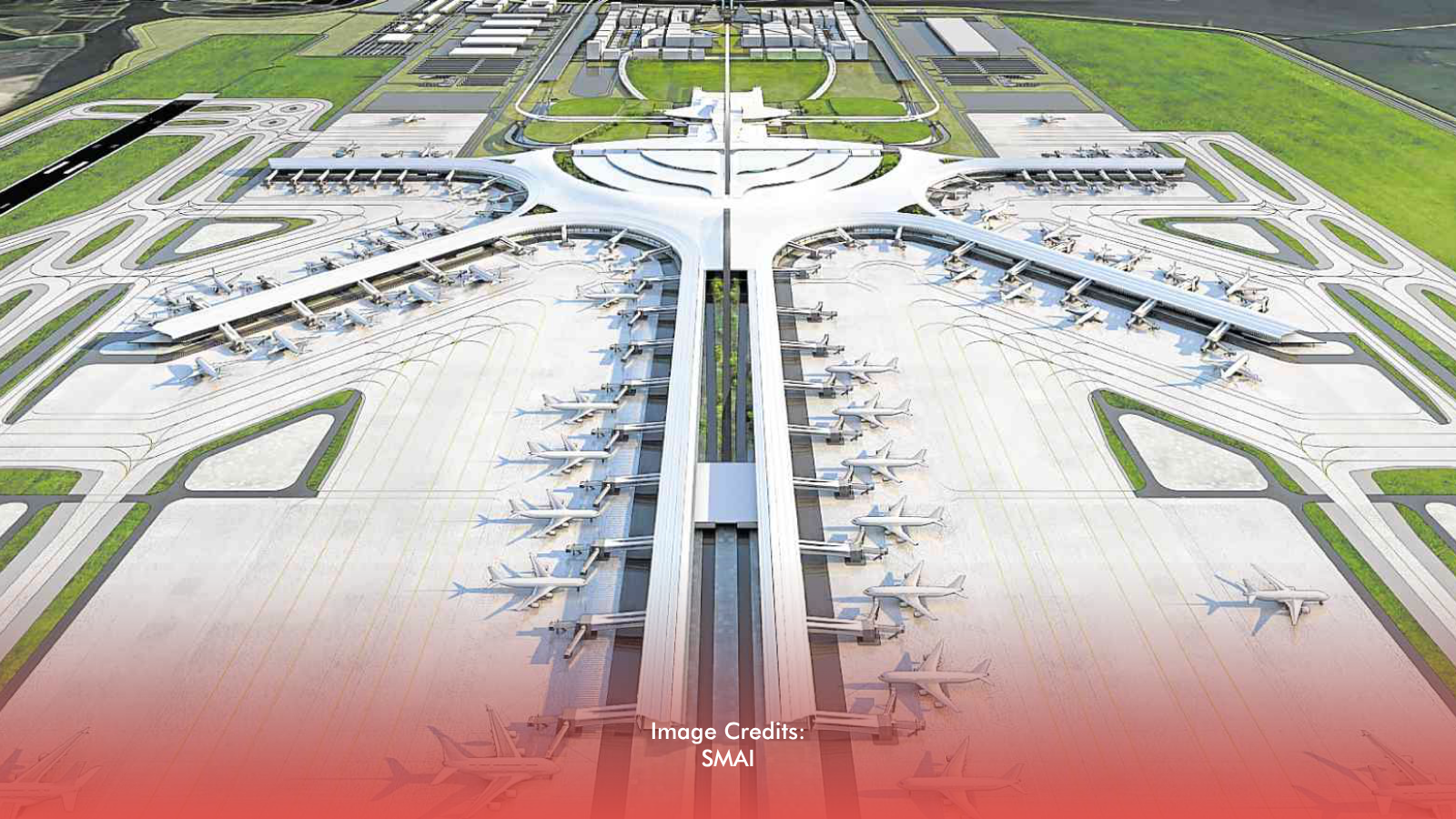
Flood resilience is a central component of the New Manila International Airport (NMIA) project in Bulacan, with its developer saying the development was planned around the province’s long-standing flooding risks. San Miguel Aerocity Inc. (SMAI) said the airport’s design incorporates measures intended to protect both the facility and surrounding communities in the low-lying coastal areas of the province.
RELATED: [Meralco 50-MVA Bustos Substation Boosts Bulacan Power Capacity]
Years of Studies Shape NMIA Flood Protection
SMAI said flood mitigation was incorporated into the airport’s master plan from Day One, with the project including an elevated airfield and terminal, enhanced drainage, river channel improvements, and water management systems extending beyond the airport footprint to benefit nearby barangay.
The company also rejected claims circulating online that connected NMIA to recent flooding in Bulacan following weeks of heavy rains. During a media briefing on Tuesday, SMAI said those claims were not supported by hydrological data, technical analysis, or an identified expert source establishing such a connection.
“NMIA did not cause Bulacan’s flooding. This is a problem the province has had to contend with for many generations. Our responsibility is to make sure the airport is built for these conditions, and that its development does not make flooding in the province worse,” SMAI said.
Ramon Ang, president and CEO of San Miguel Corporation, likewise pointed to conditions that existed before NMIA’s ongoing construction. He said flooding in Bulacan predates the project and is influenced by several factors, including the province’s low-lying geography, and the volume of rainfall.
The technical groundwork for the project’s flood considerations began in 2018, when Danish international firm DHI started extensive research, engineering studies and hydrological modeling. The work assessed surrounding rivers and coastal waters, water movement throughout the area, historical typhoons and storm surges, as well as land subsidence.
DHI’s studies also examined how raising and developing the airport site could affect drainage and flood levels in surrounding and upstream communities. In 2019, the firm conducted a river flood assessment and a larger Bulacan flood mitigation study, which determined that an engineered channel designed to improve water flow was needed to mitigate flooding risks related to the airport.
Airport Platform Raised Based on Long-Term Risk Projections
Further technical work followed in 2021, when UK-based global engineering firm Mott McDonald consolidated DHI’s models and baseline data to bring the project in line with international standards, including the environmental and social performance standards of the International Finance Corporation.
The assessment incorporated long-term land subsidence data and extreme climate change forecasts up to the year 2100. Based on these considerations, the airport platform was determined to need an elevation of at least 3.85 m to 5.50 m MSL at its center.
As construction progressed, Dutch marine engineering firm Boskalis and DHI also developed an approach intended to address land constraints while avoiding impacts on mangrove areas. Rather than relying on extensive river widening, the proposal called for deepening riverbeds while narrowing their bottom width to achieve target flows.
The approach was applied to three major rivers around the airport: the Maycapiz-Taliptip (or Alipit) River, Santa Maria River, and the Meycauayan River.
The flood issue extends beyond the airport project itself because Bulacan has long faced risks associated with its geography, rainfall, waterways, and land subsidence. The effectiveness of any major development in such an area therefore depends not only on protecting its own facilities but also on how its infrastructure interacts with surrounding drainage and river systems.
For communities in flood-prone parts of Bulacan, the real measure of these plans will ultimately be whether infrastructure can withstand worsening weather conditions without adding to the risks residents already face.
RELATED: [Bulacan to Build P10-M Animal Quarantine Facility]