Write kontemporaryo or prayoridad in a Filipino essay, and a sharp-eyed editor may circle the word and write one name in the margin: siyokoy.
National Artist Virgilio S. Almario borrowed the name of the Philippine merman for words that look Spanish but do not quite follow Spanish spelling or pronunciation. Kontemporaryo, for example, matches neither the Spanish contemporáneonor the English contemporary.
When asked why he chose the creature's name, Almario gave a blunt answer: “’Yun kasing siyokoy, pangit na nilika ’yun eh.” The siyokoy is an ugly creature.
That may be the clearest description of the syokoy. It is one of the best-known names in Philippine water lore, yet the older stories surrounding it are surprisingly scattered.
What Is a Syokoy?
A syokoy is a merman, or merman-like creature, in Philippine folklore. It is said to inhabit the sea, rivers and lakes and is often blamed for drowning people, particularly fishermen and swimmers.
The name appears in several spellings, including syokoy, siyokoy, siyukoy, shokoy and siukoy. Modern Filipino dictionaries generally use siyokoy, although syokoy remains familiar in popular culture and online searches.
The creature has also changed considerably over time. Older accounts do not always describe the same monster seen in modern drawings, television shows and fantasy stories.
What Does a Syokoy Look Like?
It depends on which version of the legend you encounter.
Folklorist Maximo Ramos recorded that some Tagalogs used the name siukoy for a merman. His description was surprisingly human: sunburned, hairy skin, wavy copper-colored hair and a scaly fish-like body below the waist.
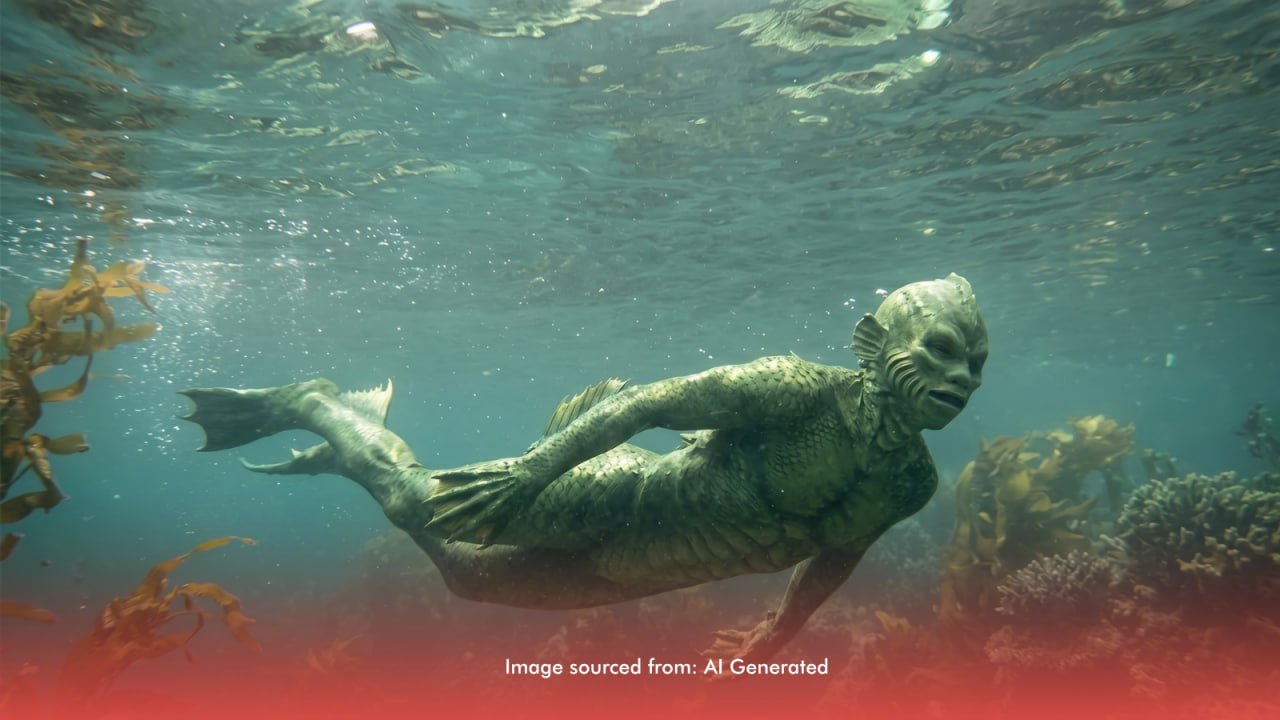
Modern descriptions are much more monstrous. Dictionaries and popular retellings describe a creature with a man's body, a fish-like head and scales. Some add webbed hands and feet, gills and bulging eyes. Others give the creature legs rather than a fish tail, making it visually distinct from the sirena and sireno.
That green, legged monster, however, is difficult to find in older written folklore. Much of the familiar image appears to have developed through komiks, television fantasy and later retellings.
Ramos's siukoy was considerably less fantastical. It sounded more like a man who had spent far too long under the Philippine sun.
Where Is the Syokoy Found?
The syokoy is not limited to the open sea.
Ramos listed siukoy and ugkoy among Tagalog and Visayan names associated with merfolk, alongside the West Visayan kataw, the Ilokano litao, the Bikol magindara and the Zambales mambubuno. He also observed that the Spanish word sirena eventually overshadowed many local names.
Stories placed these creatures in rivers, lakes and even pools beneath waterfalls.
Ramos recorded tales of mermaids living in the basin of Botocan Falls in Laguna and in the Pampanga River, while similar stories stretched from Cagayan in the north to Maguindanao in the south.
The Visayan kataw has one of the longest written records. In his 1668 history of the Visayas, Jesuit missionary Francisco Ignacio Alcina drew male and female catau alongside sharks, a dugong and rays. The dugong was drawn separately, suggesting his informants did not consider the catau to be a sea cow.
Is the Syokoy Dangerous?
In folklore, definitely.
Ramos recorded stories of merfolk pulling swimmers underwater by the legs, suddenly raising the water to seize people standing along the shore, and carrying children away to underwater homes filled with gold and jewels.
In some tales, the children were raised beneath the water and eventually married into the merfolk's world. A child taken in this way could be described as a “tribute,” while some communities used the word naserena for the victim.
Modern syokoy stories are usually simpler. The creature is portrayed as a dangerous water monster that drowns fishermen and, in some versions, eats them.
The fear behind these stories is familiar. Rivers, floods and deep water have always carried real dangers, especially in communities where crossing waterways was part of everyday life.
Where Does the Word “Syokoy” Come From?
The name appears to have come from Hokkien, the Chinese language spoken by many traders and settlers who came to Manila from Fujian.
Linguists have traced siyokoy to the Hokkien term ??, chúi-kúi, meaning “water ghost,” with the two syllables reversed. The connection appears in E. Arsenio Manuel's 1948 study of Chinese elements in Tagalog and Gloria Chan-Yap's 1980 study of Hokkien loanwords.
In Chinese folklore, a water ghost is the restless spirit of someone who drowned. Unable to leave the water, it must drag another living person into the depths to take its place.
The Philippine syokoy therefore seems to carry a Chinese drowning ghost in its name, while its fish-like appearance echoes older local traditions about merfolk such as the Visayan kataw.
Austrian scholar Ferdinand Blumentritt went further in 1895, identifying siukuy as a river god of the ancient Tagalogs. However, there does not appear to be an earlier source supporting that specific claim.
Legends of the Syokoy and Its Cousins
Some of the strangest stories surrounding Philippine merfolk are less about what the creatures look like and more about how people survive encounters with them.
In one Zambales tale recorded by Ramos, a mermaid carries a boy to her golden underwater home and asks what he ate on land. He says he ate only rice, salt and fruit. Had he said fish, meat or certain curly vegetables, she tells him, he would have become her enemy because the food resembled parts of her own body. The boy eventually escapes through a hidden door.
Other stories are closer to warnings. Ramos wrote that farmers in his hometown feared crossing a flooded stream at dusk because of the creature they believed waited in the water.
Another tale claims that merfolk sometimes joined the end of religious processions and whispered to children, “Please walk me to the edge of the water.” Ramos suspected the story may have been invented to stop children from wandering behind the procession.
What the Old Folks Say to Do
The old stories come with their own rules.
Watch what you say. If a water creature asks what you like to eat, some tales say the safe answer is rice, salt and fruit. Fish, meat and curly greens are best left unmentioned.
Stay away from flooded rivers. Folklore says merfolk wait in high water and pull swimmers under. Even without a monster, floodwater can be unpredictable and dangerous.
Keep children close. The old procession story may have been less about supernatural creatures and more about keeping children from wandering away from adults.
Show respect near the water. The familiar tabi po courtesy used when passing places believed to be inhabited by spirits can also be extended to rivers and other bodies of water.
Take drowning seriously. Behind many syokoy stories is a very real fear of people disappearing in the water. Swim where others are around and never swim after drinking.
A Monster With Two Lives
The syokoy has an unusual place in Philippine culture because its name survived in two very different worlds.
In folklore, it is a creature of rivers, lakes and seas, blamed for disappearances and drownings. In language, siyokoy became Almario's label for words that imitate Spanish but do not quite follow its rules.
Older sources also show how much the creature has changed. Alcina's 1668 manuscript depicts a male and female catauamong other aquatic animals, while Ramos's accounts describe merfolk that are far more human than the scaled monsters familiar today.
And there is one final curious detail. Ramos noted that a strong fishy smell could be a telltale sign of merfolk, even when one was disguised as an ordinary person.
So the next time someone calls a strange-looking word siyokoy, remember that the name carries a much older story.
Somewhere between the sea, a flooded river and an old Filipino folktale, there is a creature that has spent centuries changing shape.
And it still smells like fish.