
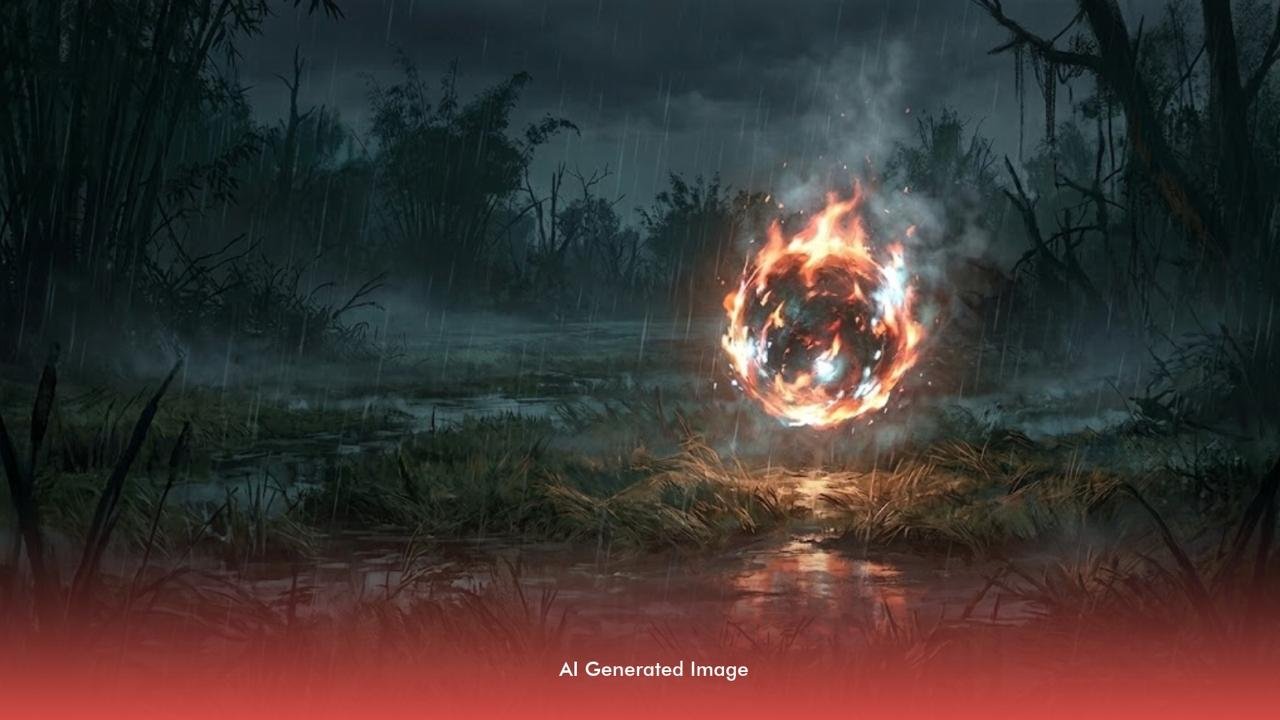
A folk tale from Oriental Mindoro begins aboard a cargo boat. Mang Ando is transporting copra, palay and bananas to Luzon when a storm rolls in. The crew spots a light in the distance. It looks red, then bluish, growing brighter until it appears to settle on the sail like a torch.
Mang Ando recognizes the mysterious flame. He splashes vinegar on it and tells his men to throw salt onto the sail. They strike at the light with poles while pouring vinegar and water over it. Eventually, the glow fades, and the weather clears.
In parts of Mindoro, the light is called santilmo. Across the Philippines, it is more widely known as the santelmo.
What Is the Santelmo?
The santelmo is a floating fireball or mysterious light in Philippine folklore. It is said to hover, bounce or roll through the darkness, appearing over stormy seas, fields, swamps and riverbanks.
Folklorist Maximo Ramos described a fireball that moves through fields and swamps, sometimes transforming into a beast with fire in its mouth. Travelers who follow it may lose their way, stumble into deep mud or thorny bushes, and wander until they become exhausted or confused.
Where Does the Name Come From?
The name comes from the Spanish San Telmo, or St. Elmo, and fuego de San Telmo, meaning St. Elmo’s fire. European sailors used the name for a blue or violet glow that sometimes appears around ship masts during storms.
The name has a complicated history. St. Elmo is associated with Erasmus of Formia, a bishop martyred around 303 and a patron saint of sailors. Spanish and Portuguese sailors also honored Peter González Telmo, a 13th-century Dominican. Over time, the two figures became associated with the same name.
The Spanish name spread through the Philippines, but local beliefs gave the light different meanings. Anthropologist F. Landa Jocano, for example, recorded the term santirmu in Malitbog alongside stories about wandering spirits.
What Does the Santelmo Represent?
The explanation varies by community. A folklore encyclopedia compiled by Francisco Demetrio records beliefs that the santelmo may be:
- The spirit of a murdered person.
- Blood that has transformed into fire.
- The soul of someone who died an early, violent or accidental death, described in some Visayan accounts as hilaw nga kamatayon.
- The spirit of someone who drowned or died at sea.
- A condemned soul or a spirit with unfinished business.
In the Oriental Mindoro story, the santilmo represents souls lost at sea. They are said to wander while paying for their sins and may set a boat’s sail on fire, putting the crew in danger.
Legends of the Santelmo
- The souls lost at sea. In one Oriental Mindoro tale, the spirits of drowned people seek something to cling to during storms. If the crew cannot drive them away, they may set the boat ablaze.
- The beast with fire in its mouth. Ramos recorded stories in which the fireball transforms into an animal with flames coming from its mouth.
- The fire that marks a killing. In some Visayan accounts, the light appears where someone was murdered or died before their time. Believers may interpret it as the victim’s burning blood.
What Could the Santelmo Be? The Science Behind the Light
The stories may describe different glowing phenomena, some of which have scientific explanations.
St. Elmo’s fire. During thunderstorms, a strong electric field can cause a corona discharge around pointed objects such as ship masts and lightning rods. The result is often a blue or violet glow, sometimes accompanied by a faint hissing sound.
The Oriental Mindoro tale resembles this phenomenon: a storm at sea, a bluish light appearing on a sail and calmer weather afterward.
In 1521, Antonio Pigafetta, the chronicler of Ferdinand Magellan’s voyage, also described a mysterious light during a violent storm near Mindanao. He wrote that “our three saints” appeared and “dissipated all the darkness.” The light associated with St. Elmo remained on the ship’s maintop “for more than two hours, like a torch.”
Ball lightning. Some santelmo stories describe a free-floating sphere of light, resembling ball lightning. This rare and poorly understood phenomenon has been reported during thunderstorms. In 2012, researchers in China recorded a luminous event and detected light associated with elements found in soil, including silicon, iron and calcium. The findings supported one proposed explanation involving lightning vaporizing soil, but the phenomenon remains scientifically unsettled.
Marsh lights. The santelmo seen over wetlands resembles will-o’-the-wisp, a mysterious light in European folklore. One traditional explanation links such lights to gases produced by decaying organic matter. In 2025, a Stanford research team reported laboratory findings suggesting that tiny electrical sparks between methane bubbles in water could produce a glow. However, this does not prove that marsh lights form this way in nature.
Some santelmo sightings may involve known electrical or atmospheric phenomena. Others remain unverified, while supernatural interpretations continue to shape local stories.
The Santelmo in Pop Culture
The santelmo gained a modern audience through Trese, the Filipino komiks series by Budjette Tan and Kajo Baldisimo. The fire spirit appears in the story as a being that paranormal investigator Alexandra Trese can summon. The 2021 Netflix adaptation introduced the creature to international viewers.
What Do the Old Stories Say You Should Do?
Traditional advice varies by region:
- Turn your clothes inside out. Ramos recorded this as a way to ward off the santelmo and help travelers find their way home.
- Use vinegar and salt. In the Oriental Mindoro tale, sailors use both to drive away the mysterious flame.
- Do not follow the light. The santelmo is said to lead travelers astray, so the traditional advice is to stay on a familiar path.
- Take thunderstorms seriously. A glow around a mast or another pointed object may signal a strong electric field. During a thunderstorm, seek appropriate shelter and avoid exposed areas. If you can hear thunder, lightning may be close enough to pose a danger.
The santelmo also has a place in Philippine religious history. Pigafetta recorded that Magellan’s crew promised offerings to St. Elmo, St. Nicholas and St. Clara after the 1521 storm, including alms. The term corposant, another name for St. Elmo’s fire, comes from the Portuguese corpo santo, meaning “holy body.” Pigafetta used the phrase “the holy body” in his account. Meanwhile, St. Peter González Telmo, one of the figures associated with the name St. Elmo, is the patron of a parish in Aparri, Cagayan.
The santelmo remains caught between folklore and science. Some mysterious lights have natural explanations, but the stories endure as a reminder of how Filipinos have made sense of danger, loss and the unknown.