Balete Drive is a 1.3-kilometer road in New Manila, Quezon City. It runs from a dead end near Diliman Creek, crosses E. Rodriguez Sr. Avenue and Aurora Boulevard, and ends at N. Domingo Street.
Today, cars, jeepneys, and taxis use it as a shortcut. Much of the road is lined with high walls and private homes.
But for more than 70 years, Balete Drive has also been known as the supposed home of the country’s most famous ghost.
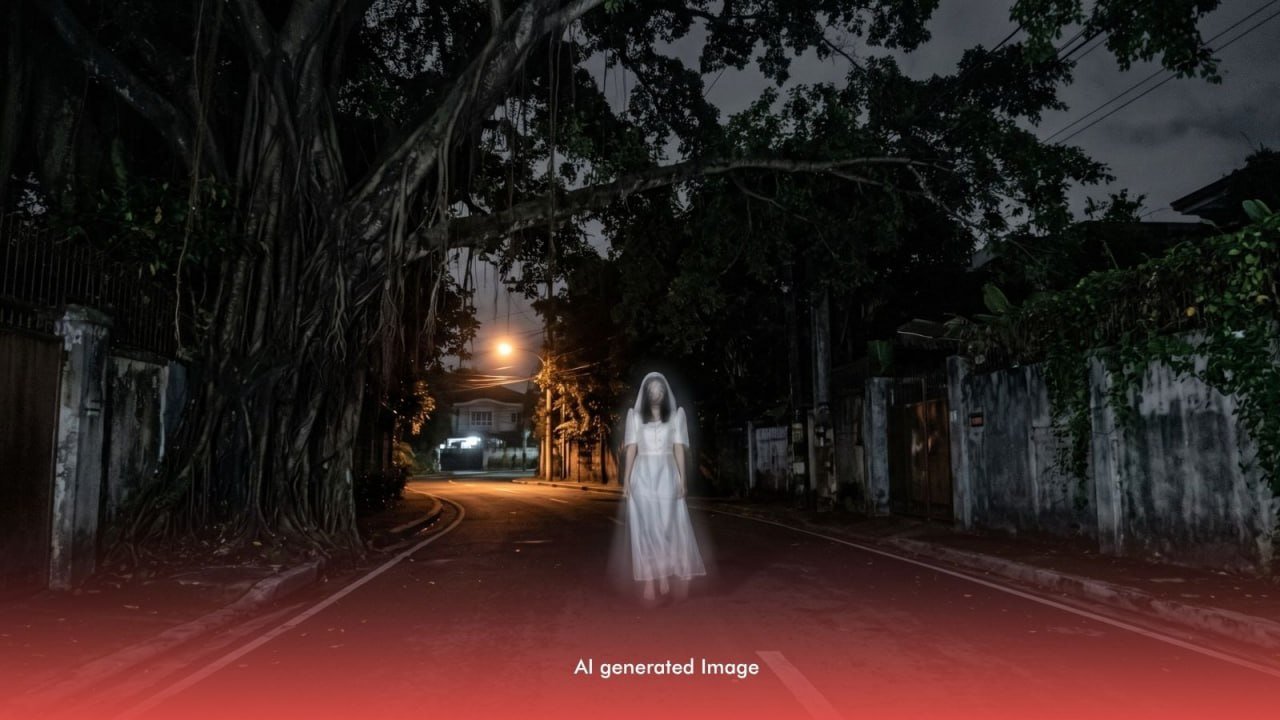
According to the legend, a woman in white appears to motorists at night. She asks for a ride, sits in the back seat, and disappears before the vehicle reaches its destination.
No one has proven that she exists. The story, however, refuses to disappear.
What Is the Legend of Balete Drive?
The basic story is simple. A driver, usually a taxi driver, sees a woman in white along the road after dark. She asks for a ride and sits in the back. When he looks into the rearview mirror or turns around to speak to her, the seat is empty.
Her identity changes depending on the version.
Some say she was a young woman run over by a taxi and buried near a balete tree. Another version says she was a UP student assaulted and killed by a cab driver. A third claims she was the daughter of one of the area's wealthy families who was killed by her relatives.
A 2022 academic study found seven versions of the Balete Drive story circulating online, with conflicting details about who she was and how she died.
Filipinos commonly call such a ghost a white lady, or kaperosa. Stories of women in white exist throughout the country, but the Balete Drive version remains the best known.
Why Are Balete Trees Considered Haunted?
The road gets its name from the balete, a group of fig trees belonging to the genus Ficus. Some accounts say a huge balete once stood in the middle of the road, while others remember several trees lining it.
The tree already had supernatural associations in Philippine folklore.
Traditional stories describe balete trees as places where spirits and engkanto live. Jesuit folklorist Francisco Demetrio collected accounts in the 1960s describing enchanted beings living in palaces hidden inside trees. The kapre, the giant tree-dwelling figure in Filipino folklore, is also commonly associated with the balete.
The tree itself can look eerie. Some balete species begin life high in another tree, sending roots toward the ground. These roots eventually thicken around the host, which dies and decomposes, leaving the mature balete hollow inside.
This may help explain why the tree became such a powerful part of Filipino supernatural stories.
Many Filipinos still say tabi-tabi po, or “excuse me,” when passing places believed to be inhabited by spirits. A UP ecologist has also argued that cultural fear of balete trees may help explain why they remain among the country's least endangered native trees.
Where Did the White Lady Story Come From?
There is no confirmed single origin.
One of the most detailed accounts came from retired lawyer Deogracias Ortega, who told the story in 2021 to his boyhood friend Buddy Gomez, a former presidential press secretary.
Ortega recalled that in 1949, teenagers took a surplus jeep for a joyride from Lantana Street, which crosses Balete Drive. On the way back, a young woman named Leni Garchitorena was driving when the jeep hit a pile of gravel on España Extension, now E. Rodriguez Sr. Avenue, near Balete Drive. The vehicle overturned, and she died in the hospital the next day.
About a week later, Ortega said, newspapers reported sightings of a woman in white hailing cars on Balete Drive. He also remembered a 1952 magazine story involving a supposed UP student.
The problem is that the 1949 newspaper reports and 1952 magazine have never been located.
Another version comes from veteran journalist Neal H. Cruz. He wrote that his first assignment at the Manila Chronicle involved the White Lady after a Quezon City police captain claimed she had disappeared from his locked patrol car at the corner of España Extension.
Cruz later found a woman who said she had been friends with the dead woman. Her version involved a hit-and-run on Balete Drive.
Then there is the possibility that the entire story was invented.
A former BusinessWorld editor recalled that newspaper founder Raul Locsin once told her that he and fellow cub reporters had “a slow day and invented the White Lady.” But journalists later described this claim as hearsay, suggesting that even the alleged hoax became an urban legend itself.
Actress Caridad Sanchez offered another theory: the story may have spread in the 1950s because motorists were being targeted by bandits in the area, and a ghost story helped keep people away.
How Did the Legend Spread?
Newspapers played a major role.
By Cruz's account, Manila newspapers in the 1950s were already heavily covering the White Lady sightings. The involvement of a police captain gave the story credibility.
Even the captain's story changed over time. Ortega remembered a Captain Babao in the late 1940s who was supposedly suspended after refusing to patrol the street. Cruz interviewed a police captain in the 1950s, while a later police reporter recalled hearing about a captain who picked up a woman in white and was suspended after refusing to return.
The story may have simply changed with every retelling.
The basic plot also resembles the international “vanishing hitchhiker” legend, which American folklorists were already documenting in the early 1940s. Balete Drive gave that familiar ghost story a distinctly Filipino setting: a dark road, a mysterious tree, and a woman in white.
What Is Balete Drive Like Now?
New Manila was once part of the Magdalena Estate, developed by Doña Magdalena Hemady and her husband, Kemal. Laid out between the world wars, it became an enclave for wealthy Manila families.
Some streets were numbered First to 13th, reportedly inspired by New York. Others were named after plants, including Sampaguita, Ilang-ilang, Dama de Noche and Balete.
The neighborhood was once much darker and more heavily wooded. Cruz recalled trees blocking the streetlights and high walls blocking light from houses. By 2013, he noted that the road was better lit and many large trees had disappeared.
The White Lady survived through popular culture. Hiwaga sa Balete Drive, released in 1988 and directed by Peque Gallaga and Lore Reyes, featured Zsa Zsa Padilla as the ghost. The legend later appeared in Trese, although its fictional “13th Street and Balete Drive” intersection does not actually exist.
In 2005, a barangay official even proposed declaring Balete Drive officially haunted as a tourism attraction.
Today, however, there is no official ghost-tour site or landmark. It is a residential street, so visitors should respect private homes and avoid photographing residents, gates or guards.
The exact balete that supposedly gave the road its name is gone, and no reliable account establishes precisely where it once stood.
The road remains.
And after more than seven decades of retellings, so does the woman in white.
So if you happen to see someone standing along Balete Drive late at night, you already know what the old stories say.
Tabi-tabi po.