
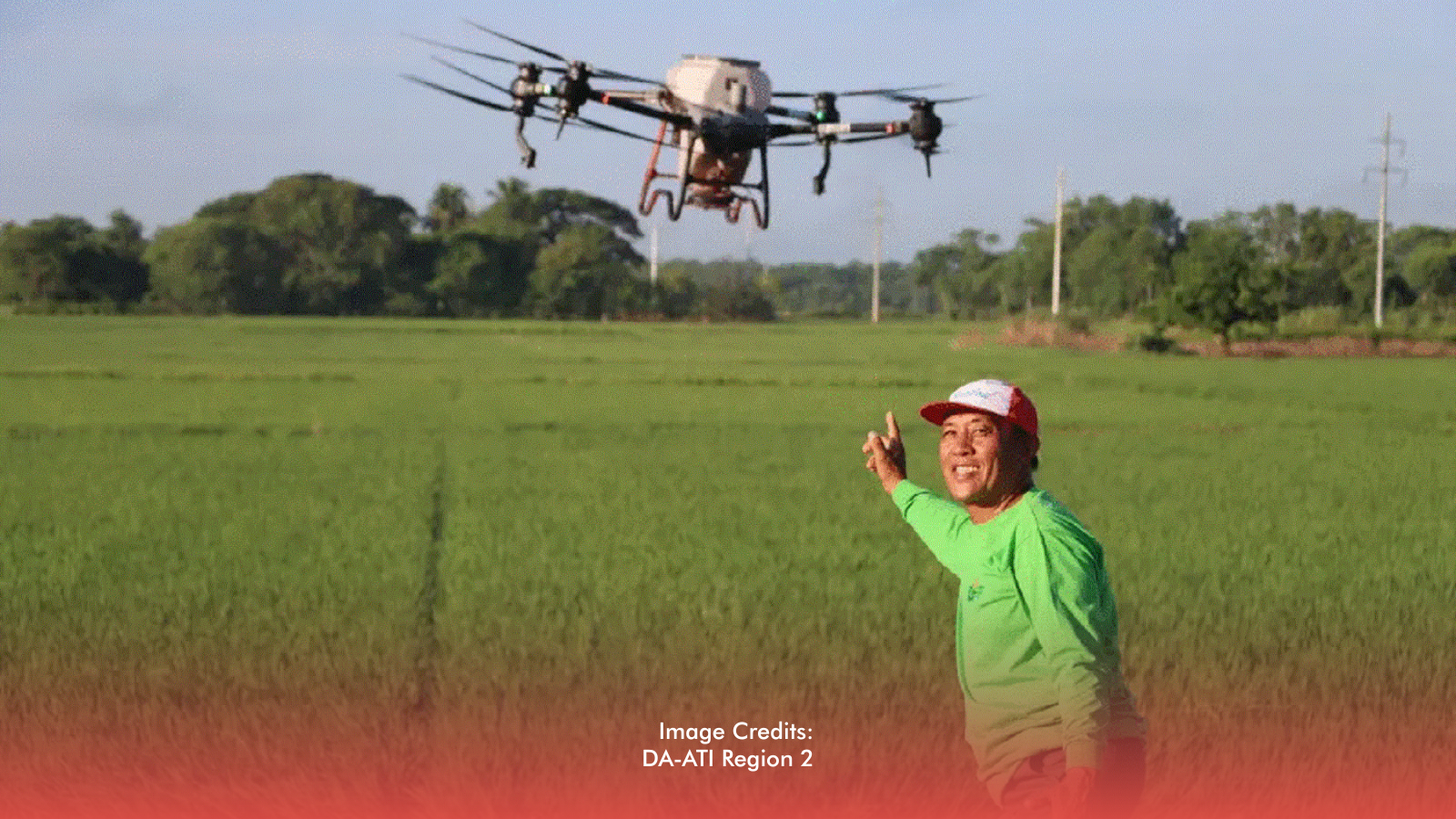
Laguna’s agricultural sector took a major leap forward on Friday, Feb. 20, as the Field Agricultural Extension Services–Office of the Provincial Agriculturist (FAES-OPA) launched a drone-assisted rice planting initiative. The project, part of a rice technology demonstration in collaboration with the International Rice Research Institute (IRRI), aims to transform traditional farming methods in Los Baños and surrounding areas.
RELATED: [New DOST Rice Transplanter Boosts Productivity, Slashes Farm Labor Needs]
By integrating drone technology into rice cultivation, farmers can achieve faster planting, reduce labor requirements, and enhance accuracy in crop management. The drone is capable of carrying up to 50 kilograms of seeds, fertilizers, and pesticides, and can also perform spraying functions.
Depending on operational settings, it can cover one hectare in 10 to 12 minutes, with optimized speed reducing the task to roughly 10 minutes. Recharge times are equally efficient, with generators restoring power in 12 to 15 minutes for continuous field work.
Precision and Safety at the Forefront
Safety and precision are central to the drone system. It is fitted with radar sensors that detect obstacles five to 10 meters away and employs RTK (Real-Time Kinematics) technology, ensuring planting accuracy within one to two centimeters. Operators are required to possess valid pilot licenses, with additional certification necessary for pesticide applications. The drone is restricted to seed and fertilizer deployment unless the operator secures all required licenses.
FAES officials highlighted that this technology represents a significant step in modernizing rice production across the province.
“The drone-assisted approach reduces manual labor, accelerates planting operations, and allows for precise placement of seeds and fertilizers,” they said, emphasizing that the method can improve crop yields while promoting more sustainable farming practices.
The adoption of drone technology in rice farming signals broader benefits for the Filipino farmer and the agricultural sector. By lowering labor dependency and increasing efficiency, it enables smallholder farmers to boost productivity, reduce costs, and adopt more sustainable cultivation methods, ultimately contributing to greater food security in the Philippines.
RELATED: [Cagayan To Establish P275-M Rice Processing Center For Agri Modernization]