
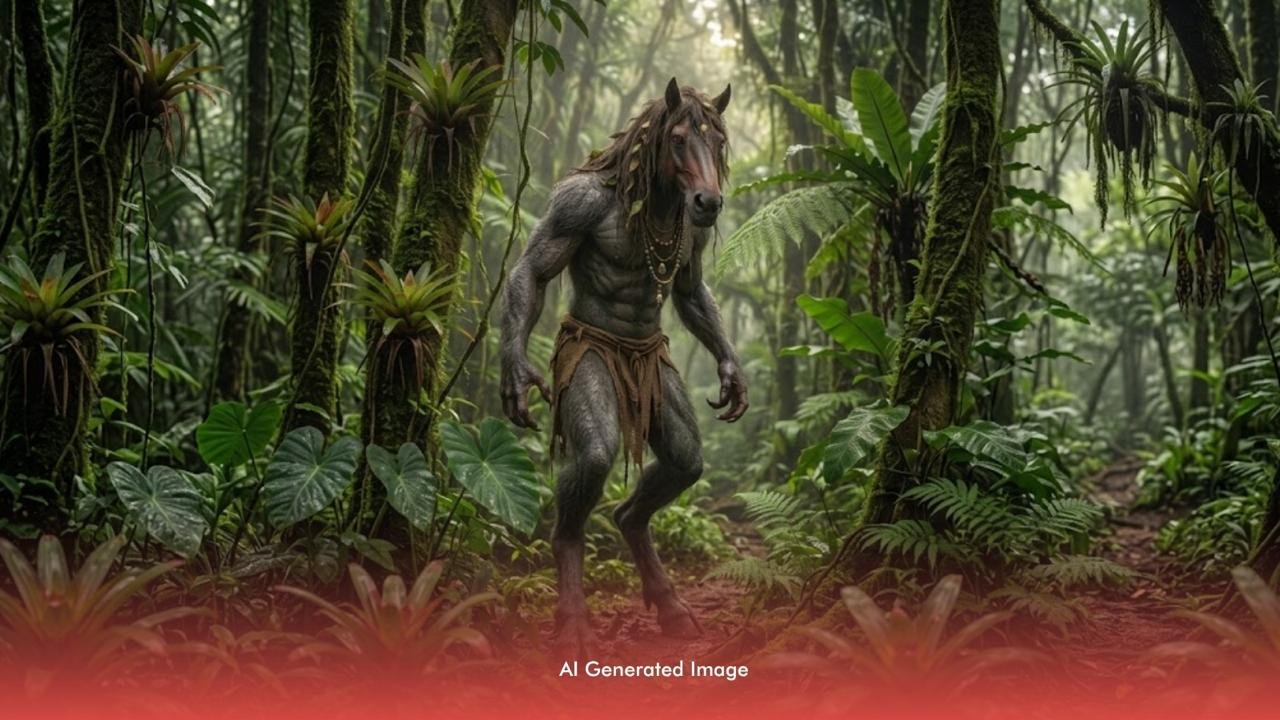
When rain falls from a sunny sky, many Filipinos have a familiar explanation: kinakasal ang tikbalang (a tikbalang is getting married).
Nobody expects to see the wedding, of course. But the saying keeps alive a creature Filipinos have been naming for at least four centuries, even as its appearance has changed over time.
What Is a Tikbalang?
The tikbalang is a trickster spirit in Philippine folklore, traditionally associated with forests, mountains, bamboo groves and lonely roads.
Today, it is usually imagined as a very tall, thin, long-limbed creature with the head and hooves of a horse. Its knees are said to rise above its head when it squats.
Its favorite trick is getting people lost.
Travelers may find themselves walking in circles or repeatedly returning to the same spot. The tikbalang is also said to imitate familiar voices, disappear from sight and change its form.
It Didn't Always Have a Horse's Head
The written record shows that the tikbalang has gone through several transformations.
In 1589, Franciscan friar Juan de Plasencia mentioned creatures called Tigbalaang among Tagalog beliefs, describing them simply as “phantoms.” There was no horse or detailed physical description.
The 1613 Tagalog-Spanish dictionary Vocabulario de la lengua tagala gives a stranger version. Its tigbalang had wings and could carry people wherever it wanted. Those taken away were said to weaken and eventually die.
It also described an older form as very tall, with long hair and small feet. After the arrival of the missionaries, it claimed people could no longer see the creature but could supposedly smell it in the mountains.
Did you know? The 1613 dictionary is one of the earliest written records of the tikbalang, and its version looks nothing like the horse-headed creature Filipinos recognize today.
By around 1731, Augustinian friar Tomás Ortiz described it as taking several forms, including a black man, an old man, a horse or a monster. In 1763, Antonio Mozo described it as having the body of a giant and the legs of a horse.
The familiar horse-faced version appears more clearly in Jesuit Juan José Delgado's writings from the 1750s. He recorded a boy from San Mateo who described a very tall, thin figure with a long horse-like face, unusually long ears and nose, short horns and the mouth of a horse.
When it squatted, its shins rose above its head.
Where Is the Tikbalang Found?
The name tikbalang is Tagalog, and most early written accounts come from Tagalog areas.
But similar horse-like beings appear elsewhere in Philippine folklore.
Delgado noted that Visayans called the creature unglo. Folklorist Maximo Ramos later compared it with beings such as the tulung, described among the Ayta near Mount Pinatubo, and the Dumagat binangenan, a horse-like creature said to have fire along its back.
These are distinct beings with their own traditions, but their similarities show how widespread horse-like supernatural creatures are in Philippine folklore.
Is the Tikbalang Dangerous?
Modern stories often portray the tikbalang as more mischievous than deadly. It gets you lost, scares you and wears you out.
Older accounts were darker.
Delgado wrote that a tigbalang could carry children deep into the forest and leave them in trees, feeding them wild fruit they could not eat until they wasted away.
In 1803, Joaquín Martínez de Zúñiga wrote that Tagalogs were “greatly afraid” of it.
Yet some people were said to seek its favor. Ortiz wrote that people befriended tigbalangs, giving them rosaries in exchange for hairs, herbs and stones believed to help with their affairs.
A 1966 account from San Pablo, Laguna, collected by folklorist Francisco Demetrio, described a female tikbalang as a beautiful woman who bathed under the full moon and became attached to one family for generations.
Why Do Filipinos Say a Tikbalang Is Getting Married?
The phrase kinakasal ang tikbalang is one of the creature's most familiar modern associations.
It turns strange weather into a story: when the sun shines while rain falls, somewhere, supposedly, a tikbalang is having a wedding.
The idea even made its way into theater. In 2011, Dulaang UP staged Umaaraw, Umuulan, Kinakasal ang Tikbalang, featuring the legendary figures Makiling, Sinukuan and Cacao among the wedding guests.
Can You Tame a Tikbalang?
According to one old story, you can.
An account attributed to Isabelo de los Reyes's 1890 El Folk-Lore Filipino describes a tikbalang with a mane of sharp spines.
A person brave enough to tame one had to leap onto its back, tie it with a specially prepared cord and hold on while it tried to throw them off.
Once the creature became exhausted, the rider was supposed to pull out one of its three thickest spines. Kept as an anting-anting, the spine was said to give its owner power over the tikbalang.
Later retellings turned the spines into three golden hairs.
Where Did the Horse Come From?
The name tikbalang was already in use when the Spanish arrived, but the horse appears to have become part of its image later.
Horses were not native to the Philippines and became more common during the colonial period. The large and unfamiliar animal may have provided a striking new form for an old forest spirit.
There is also a popular theory connecting the tikbalang to Hayagr?va, the horse-headed figure in Hindu and Buddhist traditions. But there is no known Philippine object or text directly linking the two.
The Tikbalang in Pop Culture
The creature has continued to evolve outside traditional folklore.
In 1971, sculptor Solomon Saprid created a gangly bronze tikbalang as a flower child, complete with a guitar and peace pendant.
Did you know? Saprid's tikbalang was literally a guitar-playing flower child, reflecting the counterculture of its time.
The creature also appears in Arnold Arre's The Mythology Class and in Trese, where Maliksi, son of a tikbalang clan leader from Bukidnon, drag-races Alexandra Trese.
In the 1880s, Filipino writer Mariano Ponce also used “Tikbalang” as a pseudonym for some of his writings in La Solidaridad.
Four Tikbalang Legends
The girl in the nipa. In the 1750s, Delgado recorded a story about a girl from Santa Cruz taken by a tigbalang. After her family prayed before the Virgin Mary, she was found three days later, starving in a nipa thicket.
The San Mateo boy. A boy escaped a tikbalang after someone placed a medal of St. Ignatius on him. His description became one of the earliest detailed accounts of the horse-faced creature.
The hidden bride. In Malabohoc, a newly married woman was reportedly carried away by an unglo. Searchers passed her repeatedly without seeing her until she was eventually found beneath a large tree.
The white horse of Calapan. A fisherman and his son once saw a white shape hovering over the water at midnight. It became a large white horse before disappearing. The father identified it as the local tikbalang.
What the Old Folks Say to Do
Turn your shirt inside out. The classic remedy when a familiar path suddenly seems to loop.
Say tabi po. Before entering a forest, bamboo grove or unfamiliar trail, politely ask permission to pass.
Don't answer familiar voices. A tikbalang is said to imitate people you know.
Carry something blessed. Old accounts mention rosaries and medals as protection.
And, realistically, don't get lost. Stick to marked trails, travel during daylight when possible and let someone know your route.
The tikbalang has had quite a makeover over the centuries: phantom, winged kidnapper, horse, horse-faced giant and even bronze hippie.
But one thing has stayed remarkably consistent.
Someone walks into the woods, takes a path they've used before, and somehow ends up right back where they started.
Maybe they got turned around.
Or maybe they just forgot to say, tabi-tabi po.