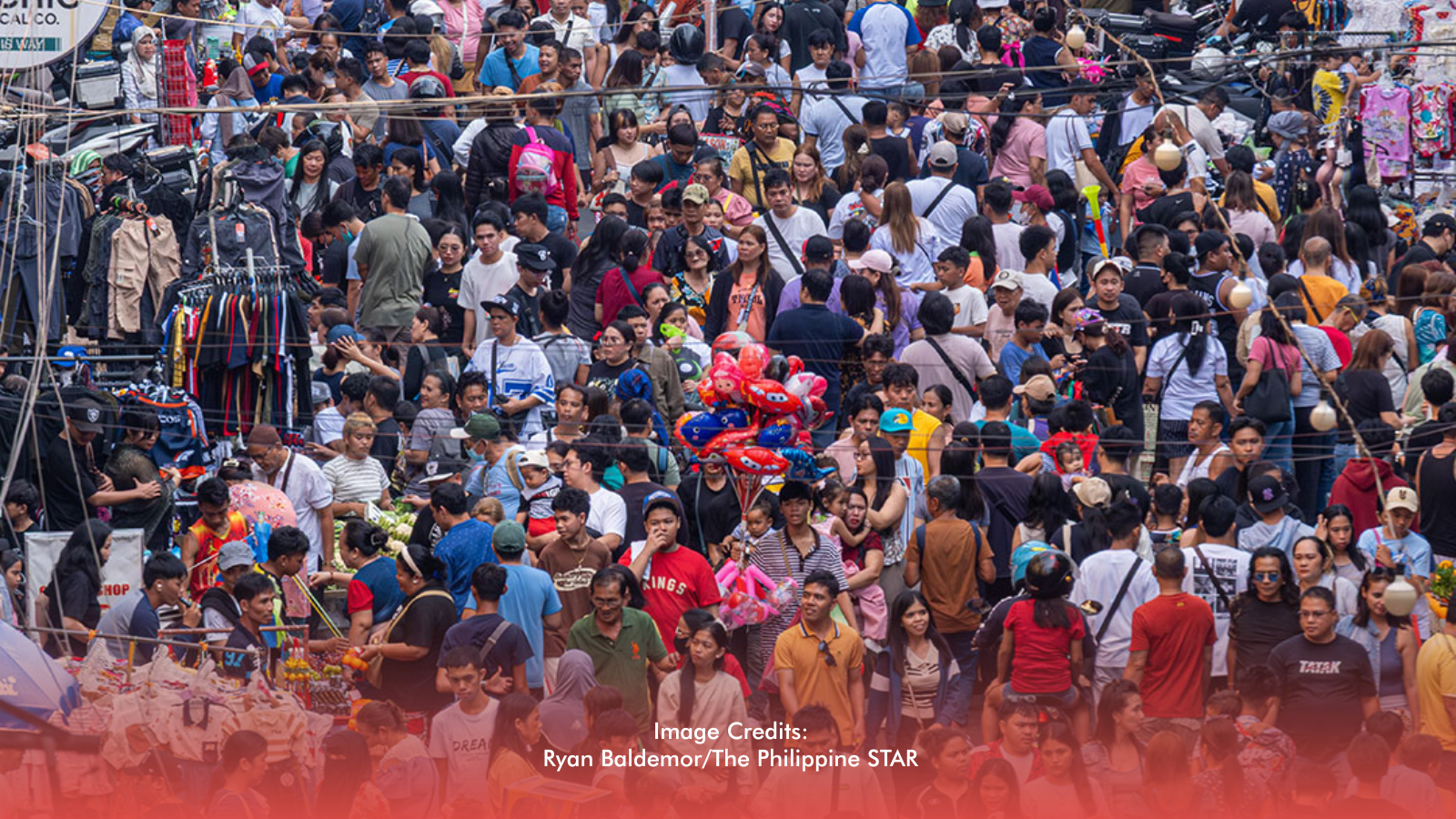
The Philippine population is expected to continue expanding over the next decade, with official projections showing the country nearing the 124-million mark by 2035. Data released by the Philippine Statistics Authority (PSA) point to steady growth driven by regional population increases, even as some areas begin to experience slower expansion.
Based on the 2020 Census of Population and Housing, the PSA estimates that the country’s mid-year population will rise from 109.20 million in 2020 to 123.96 million in 2035. This represents an increase of nearly 15 million people over the 15-year period and translates to an average annual growth rate of 0.85 percent. As of July 2024, the Philippine population stood at 112.7 million.
Regions Driving Population Growth
Calabarzon, comprising Cavite, Laguna, Batangas, Rizal, and Quezon, is projected to remain the country’s most populous region through 2035, with an estimated population of 19.07 million. The region already posted the largest population in 2024 at 16.93 million. It is followed by the National Capital Region with a projected 14.49 million residents and Central Luzon with 14.02 million.
At the other end of the spectrum, the Cordillera Administrative Region is expected to remain the least populous, with a projected population of 2.13 million by 2035. The PSA also noted a shift in regional distribution, with the number of regions having populations of at least five million increasing from nine in 2020 to 12 by 2035. Eastern Visayas, Soccsksargen, and the Bangsamoro Autonomous Region in Muslim Mindanao (BARMM) are projected to cross the five-million threshold.
Shifting Trends by Sex and Location
Population projections by sex show that most regions will have more males than females by 2035, except for NCR and BARMM. In NCR, females are projected to slightly outnumber males, with 7.29 million women compared with 7.20 million men, resulting in a sex ratio of about 99 males for every 100 females. BARMM is expected to have an almost balanced distribution, with about 3.201 million females and 3.196 million males.
Growth trends vary across regions. BARMM is projected to post an increase in its average annual growth rate from 1.62 percent between 2020 and 2025 to 1.79 percent from 2030 to 2035, reflecting what the PSA described as “robust population growth.” In contrast, NCR, Calabarzon, Central Luzon, and several other regions are expected to see a gradual slowdown in population growth.
At the provincial level, Cavite is projected to remain the most populous province by 2030 with 5.30 million people, followed by Bulacan at 4.17 million. Among highly urbanized cities, Quezon City is projected to remain the most populous by 2030 despite a slight decline to 2.92 million.
For the average Filipino, these projections highlight growing pressure on housing, transportation, jobs, education, and healthcare, underscoring the need for long-term planning to ensure that population growth translates into inclusive development rather than strained public services.