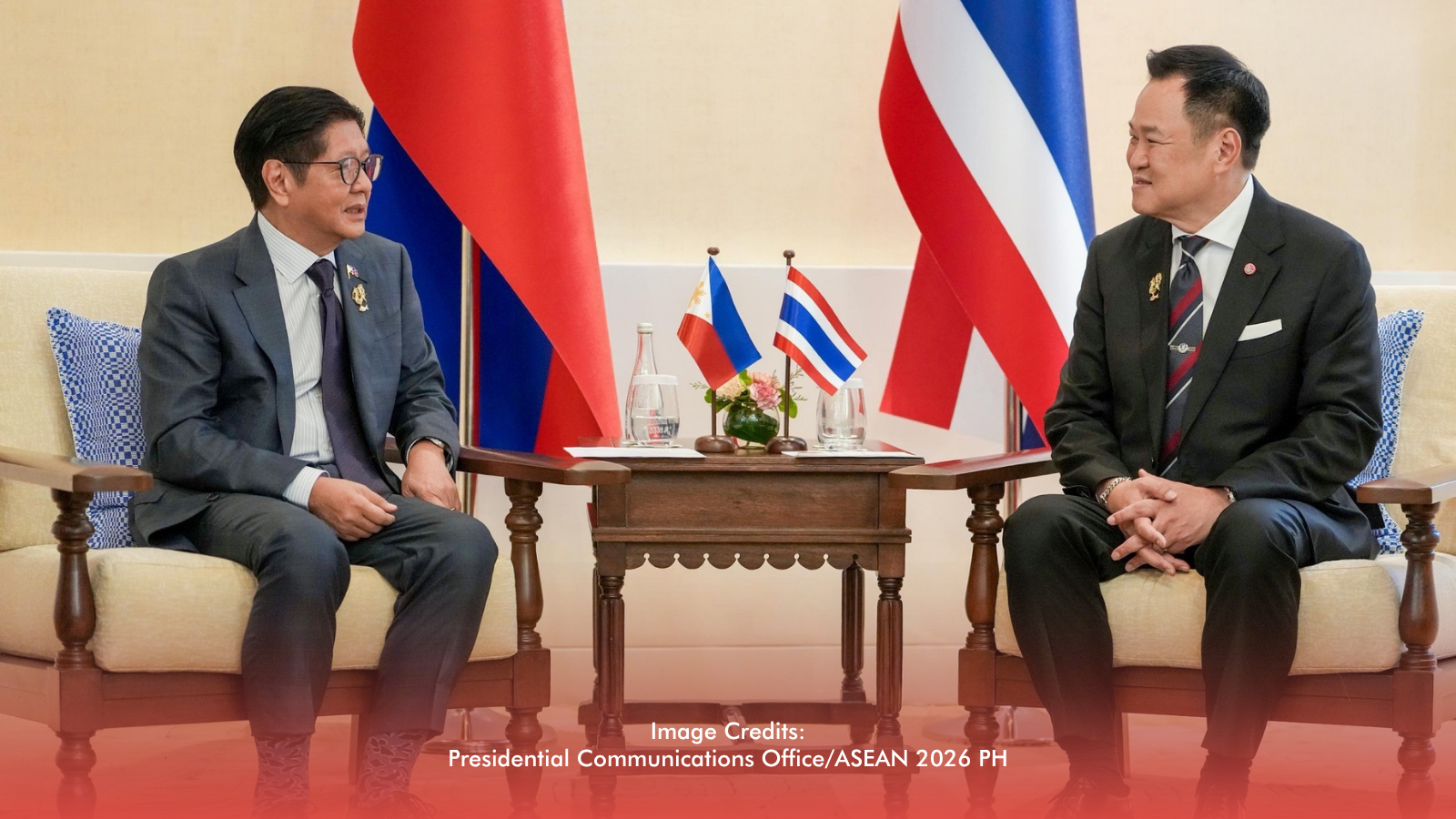
The Philippines and Thailand have agreed to deepen cooperation in trade, economic growth, people-to-people exchanges, and regional security following high-level talks in Cebu. The meeting took place a day after the 48th Association of Southeast Asian Nations (ASEAN) Summit and Related Meetings, reinforcing efforts to strengthen long-standing ties between the two countries.
RELATED: [What is ASEAN and Why Does It Matter?]
Strengthening ASEAN Cooperation Amid Regional Challenges
The discussions were held between President Ferdinand Marcos Jr. and Thai Prime Minister Anutin Charnvirakul, where both leaders reviewed key areas for expanded collaboration. According to the Presidential Communications Office (PCO), the dialogue covered economic partnerships, regional stability, and joint efforts against transnational crime.
“The two leaders exchanged views on enhancing bilateral relations through high-level exchanges, trade and economic cooperation, people-to-people ties, and cooperation in combating transnational crimes,” the PCO said in a statement.
The office also noted that the leaders tackled broader global and regional concerns, reaffirming their commitment to ASEAN solidarity and continued cooperation for peace and stability across Southeast Asia.
“President Marcos and the Thai Prime Minister also discussed regional and global issues of shared concern, reaffirming both nations’ commitment to Asean solidarity, regional peace, and stability,” it added.
Anutin’s participation in the talks comes as he becomes the first Thai prime minister in two decades to be re-elected, with his government expected to face multiple regional issues, including geopolitical tensions and border disputes in Southeast Asia.
President Marcos also played a facilitative role in earlier discussions involving Thailand and Cambodia, underscoring the Philippines’ effort to encourage peaceful dialogue among ASEAN members. The initiative aimed to help ease long-standing tensions between the two neighboring countries.
“This meeting was arranged by the Philippines as a way to provide its good offices in our capacity as chair of Asean for 2026,” Marcos said during a joint press conference after the talks.
He added that the engagement highlighted ASEAN’s shared commitment to diplomacy, restraint, and peaceful resolution of conflicts amid ongoing regional challenges.
Commitment to Peace, Dialogue, and Regional Stability
Both sides agreed to direct their foreign ministries to maintain continuous communication and explore diplomatic steps to prevent further escalation of tensions. The ASEAN Observer Team’s mandate was also extended for another three months to support peace efforts.
Marcos reiterated that the Philippines will continue facilitating dialogue initiatives as part of its role in promoting regional cooperation and stability within ASEAN.
“I believe this was possible because of a very clear, fervent belief by both leaders that it is time for peace and no longer the time for war,” Marcos said.
Thailand and Cambodia also expressed appreciation for the Philippines’ role in mediating discussions.
“Thailand and Cambodia are two neighboring countries. It is best that we avoid conflict—it only brings losses and suffering,” Anutin said. “Now is the time for us to look forward and walk this path together toward peace. This requires sincerity, good faith, and determination,” he added.
Hun Manet, for his part, said, “the Philippines’ constructive leadership in promoting regional peace, stability, and unity is commendable.”
These diplomatic efforts matter because stronger regional cooperation can help stabilize trade, improve security coordination, and support a more peaceful Southeast Asia, conditions that directly influence economic opportunities and everyday stability in the country.