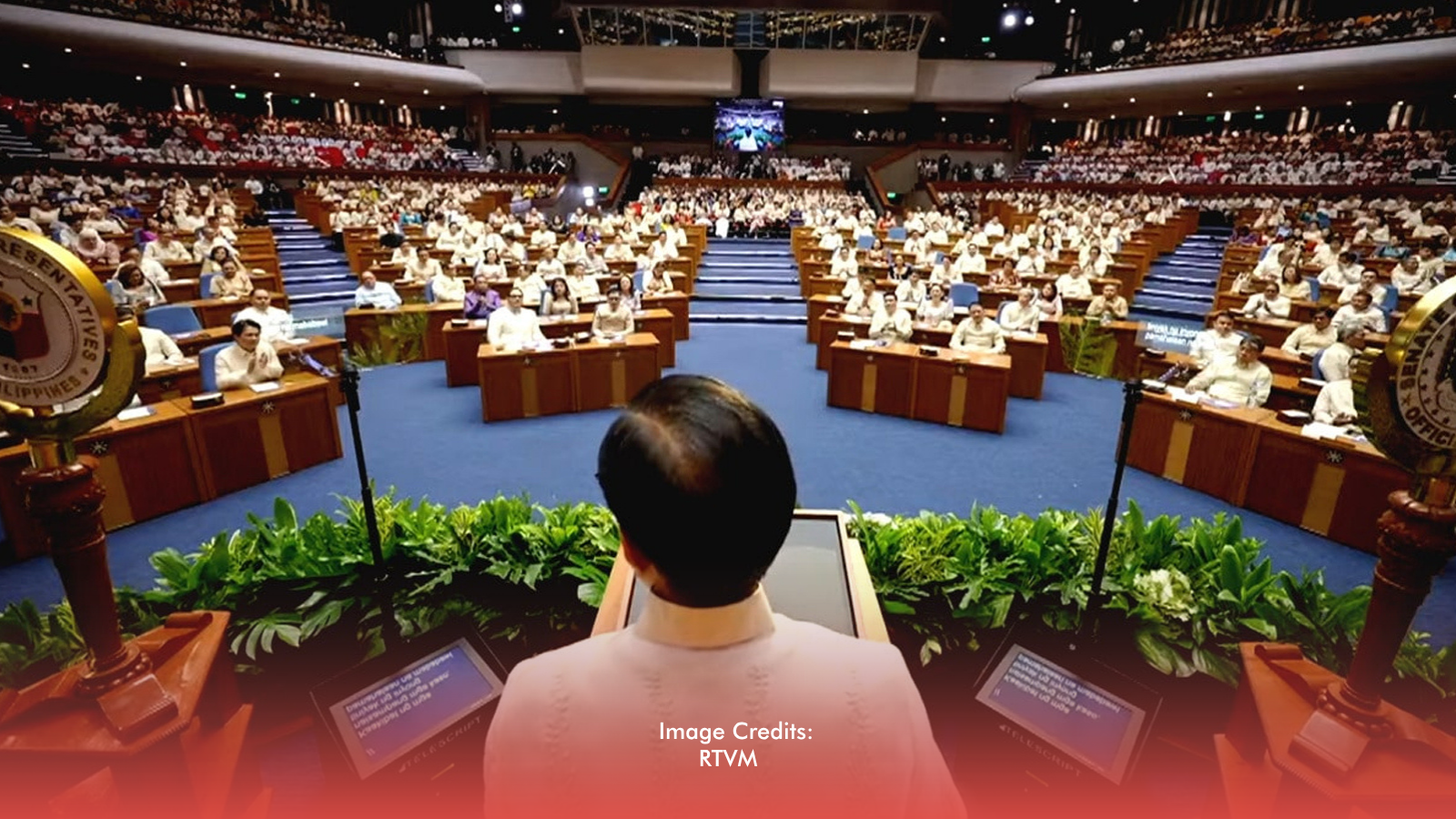
President Ferdinand Marcos Jr. outlined a broad domestic agenda in his State of the Nation Address (SONA), promising tax relief, expanded social protection, infrastructure development, and stronger economic reforms while reaffirming the country's position on the West Philippine Sea.
Among the key proposals was amending the Electric Power Industry Reform Act (EPIRA) to remove systems loss charges from electricity bills, a move that earned a standing ovation during the address.
Marcos also proposed increasing the income tax exemption threshold to P350,000 annually to benefit workers and micro, small, and medium enterprises (MSMEs), alongside a tax amnesty program covering penalties.
The administration allocated more than P60 billion for the Pantawid Pamilyang Pilipino Program (4Ps) and the Walang Gutom Program, while an additional P58 billion was set aside to cushion the impact of the Middle East conflict. Workers will also benefit from a P10,000 increase in the maximum Pag-IBIG loan amount.
To stimulate business growth, Marcos reiterated support for the CREATE MORE Act and the Ease of Paying Taxes Act.
Infrastructure, Agriculture, and Education Priorities
The President said portions of the North-South Commuter Railway and MRT-7 are expected to begin partial operations by 2027 as part of the government's transport modernization efforts.
On governance, he announced that more than P800 million from anomalous flood control projects had been recovered and returned to the national treasury, adding that reforms are underway within the Department of Public Works and Highways (DPWH).
Marcos also highlighted agricultural support, citing P19 billion in insurance payouts to farmers and fisherfolk over the past four years. He called for stronger measures against avian flu and African Swine Fever (ASF) and urged Congress to amend the Rice Tariffication Law, the Coconut Farmers Trust Fund Act, and the Fisheries Code.
In education, the President reported the promotion of over 80,000 public school teachers and school heads through the Expanded Career Progression Program, along with the creation of 30,000 new teaching positions.
Rights Groups, Civic Leaders Call SONA Lacking
Despite receiving applause inside the plenary, the President's address drew criticism from rights advocates and civic leaders who said it failed to address pressing concerns on human rights, the environment, and peacebuilding.
Former Bayan Muna Representative Carlos Zarate gave the SONA a failing mark, saying it relied on "populist rhetoric" without offering concrete solutions. He pointed to the absence of proposals on the anti-political dynasty law, the communist peace process, and the country's human rights situation.
Fr. Raymond Ambray, director of the Indigenous Peoples' Apostolate of the Diocese of Tandag, rated the administration five out of 10, arguing that its record on environmental protection and human rights has worsened.
Lian Buan, Philippine researcher for Human Rights Watch, also criticized the speech for its "total omission" of human rights issues, citing continued concerns over red-tagging, the remaining effects of Oplan Tokhang, and cases involving human rights defenders.
Meanwhile, Kusog Mindanaw chairman Charlito Manlupig acknowledged that the President addressed key issues such as the West Philippine Sea, tax reforms, and corruption but said the speech lacked a long-term strategic vision.
Describing it as "a SONA full of 'sana,'" Manlupig said the administration's promises must now be matched with concrete action, noting that the government has only two years left to fulfill its commitments.