A new technology facility in Sorsogon is set to strengthen the country’s seaweed industry by improving the availability and quality of planting materials for farmers. The Department of Agriculture (DA) said the country’s first seaweed bioreactor is expected to help increase production, support exports and provide disease-free planting materials throughout the year.
RELATED: [Sen. Pangilinan Calls for Wider Use of Tech in Farming and Fishing]
New Technology for Better Seaweed Propagation
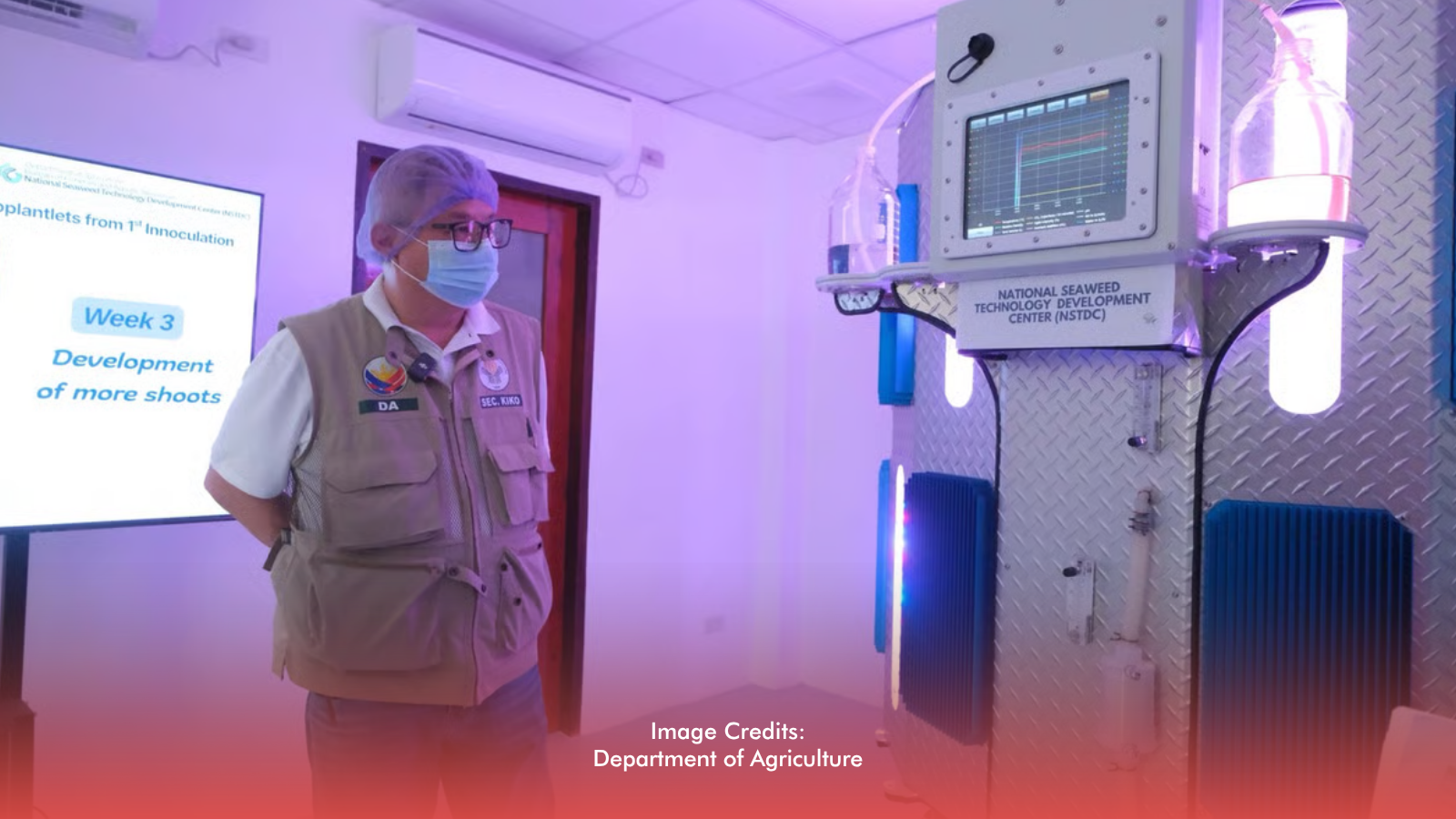
The automated 1,250-liter bioreactor, worth P10 million, was launched on July 20 and installed at the Bureau of Fisheries and Aquatic Resources’ (BFAR) National Seaweed Technology Development Center in Sorsogon. Additional modular seaweed bioreactors, separately valued at P12 million, are also part of the initiative.
Agriculture Secretary Francisco Tiu Laurel Jr. highlighted the significance of the facility, saying, “This is the first facility of its kind in the Philippines. We can now produce seaweed propagules on demand,”
Seaweed propagules are living parts of algae, including spores, zygotes or vegetative cuttings, that can be used to grow new seaweed. They function similarly to seeds by allowing the species to spread, attach to surfaces and begin new life cycles in oceans or aquaculture farms.
The new system replaces laboratory practices that had relied for decades on improvised bottles, manual aeration and less precise propagation methods. By controlling light, nutrients, and temperature, the bioreactor allows BFAR to produce healthier seaweed propagules more quickly and in larger quantities.
The planting materials will be distributed free nationwide, with the goal of improving harvests and limiting losses associated with poor-quality seedlings. Initial batches will be sent to Zamboanga, Palawan, and the Bangsamoro Autonomous Region in Muslim Mindanao, followed by Cebu, Iloilo, Camarines Sur, Camarines Norte, and Masbate.
BFAR will also provide training to farmers before the planting materials are distributed to help improve survival rates and yields.
Strengthening a Key Export Industry
The initiative is part of the government’s effort to provide clean and disease-free planting materials across Luzon, Visayas, and Mindanao while helping the Philippines regain its position as the world’s leading producer of Kappaphycus seaweed.
The DA said the Philippines remains among the world’s largest producers of carrageenan-bearing seaweeds. These seaweeds provide raw materials used internationally in food processing, pharmaceuticals, cosmetics, and a wide range of industrial products.
Despite its established role in the global industry, the country currently ranks fourth as a seaweed producer, accounting for 4.2 percent of the global market. Kappaphycus alvarezii contributes most of the country’s production, according to the Department of Science and Technology.
The government is also examining the possibility of establishing additional bioreactor facilities in Palawan and Mindanao to increase production capacity. At the same time, research is being accelerated into new seaweed varieties that could be used for food, pharmaceutical, industrial and organic fertilizer applications.
For Filipino seaweed farmers, access to healthier planting materials and improved propagation technology could help address production losses while supporting more consistent harvests. At the national level, strengthening the seaweed sector could benefit coastal communities, expand opportunities in the fisheries and agricultural economy, and help the Philippines compete more strongly in a global market that supplies materials for everyday products.
RELATED: [DOST Introduces Solar-Powered Pumps For Climate-Resilient Agri In Aurora]