
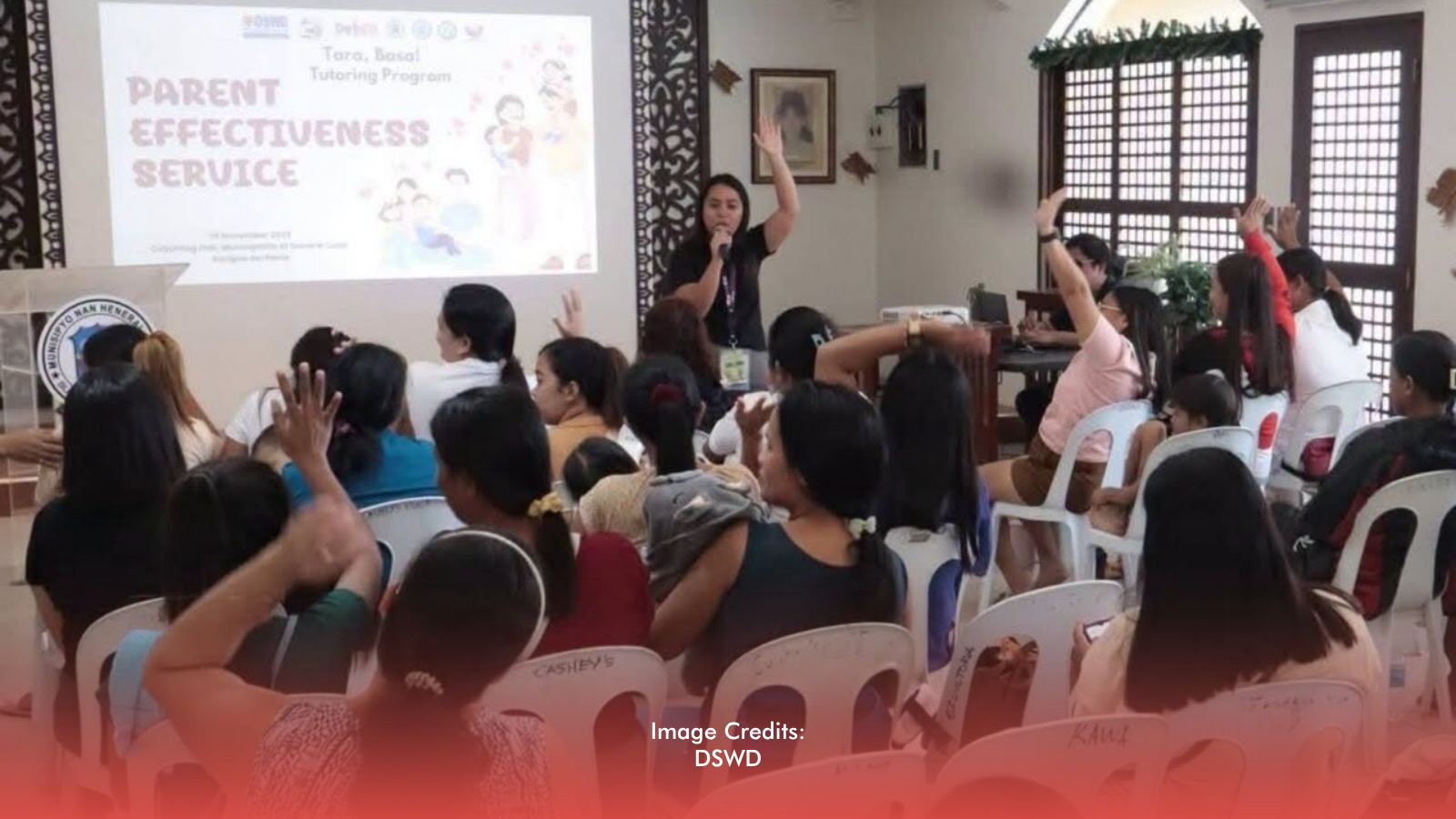
Children’s emotional needs cannot be addressed by digital connections alone, the Department of Social Welfare and Development (DSWD) said, as it moves to broaden a program that helps parents and guardians provide support at home.
The agency is seeking to strengthen its Parenting Effectiveness Service (PES), emphasizing the role of active parental involvement in children’s well-being.
Established under Republic Act 11908, the PES trains parents and guardians in responsible parenting, child protection, and positive discipline. The initiative is also part of the DSWD’s wider response to the recent school shooting in South Cotabato, where affected learners continue to need psychosocial support.
RELATED: [DSWD Rolls Out Mobile Hubs to Connect Families With Gov't Services]
Parenting Program to Reinforce Support at Home
Assistant Secretary Irene Dumlao, DSWD spokesperson, said on PTV’s Bagong Pilipinas Ngayon on Monday that the agency intends to expand PES implementation through coordination with government agencies and local government units.
“We recognize that we have to expand the implementation of the PES. That's why we will cooperate with various government agencies and local government units so that we can strengthen and strengthen the family, the family relationship, and the performance of parental responsibilities of the parents,” Dumlao said in Filipino and English.
Dumlao stressed that children should be able to turn to their parents when dealing with personal concerns, rather than depending exclusively on “digital friends” for emotional comfort. The DSWD is working with LGUs, the Department of Education (DepEd), and the Philippine National Police (PNP) to provide multidisciplinary, trauma-informed care and psychological first aid to students, families, and academic staff affected by the shooting.
The agency will also shoulder medical expenses for injured survivors and burial costs for families of those killed. Livelihood assistance services will be extended to help affected families recover.
Mental Health Experts Emphasize Emotional Safety
Dr. Noel Reyes, medical center chief of the National Center for Mental Health (NCMH), said protecting students involves more than securing their physical surroundings. Children also need reassurance and dependable adults who can help them process difficult experiences.
"Children must also feel emotionally safe, supported and assured that trusted adults are available to help them," Reyes said.
Following traumatic or violent incidents, students may show signs of stress such as fear, irritability, sleep disturbances, sudden physical complaints, and reluctance to attend school. Reyes said these reactions call for timely, compassionate intervention rather than being brushed aside.
"Alongside physical security, schools must provide timely, compassionate, and accessible psychological support," he added.
The response to the South Cotabato shooting highlights the need to treat children’s emotional recovery as part of their safety. Stronger family support, accessible mental health care, and coordinated assistance can help affected students regain a sense of security, while reminding communities that protecting children requires attention both inside and outside the classroom.
RELATED: [Good News! DSWD GLs Now Accepted In 262 Mercury Drug Branches]