
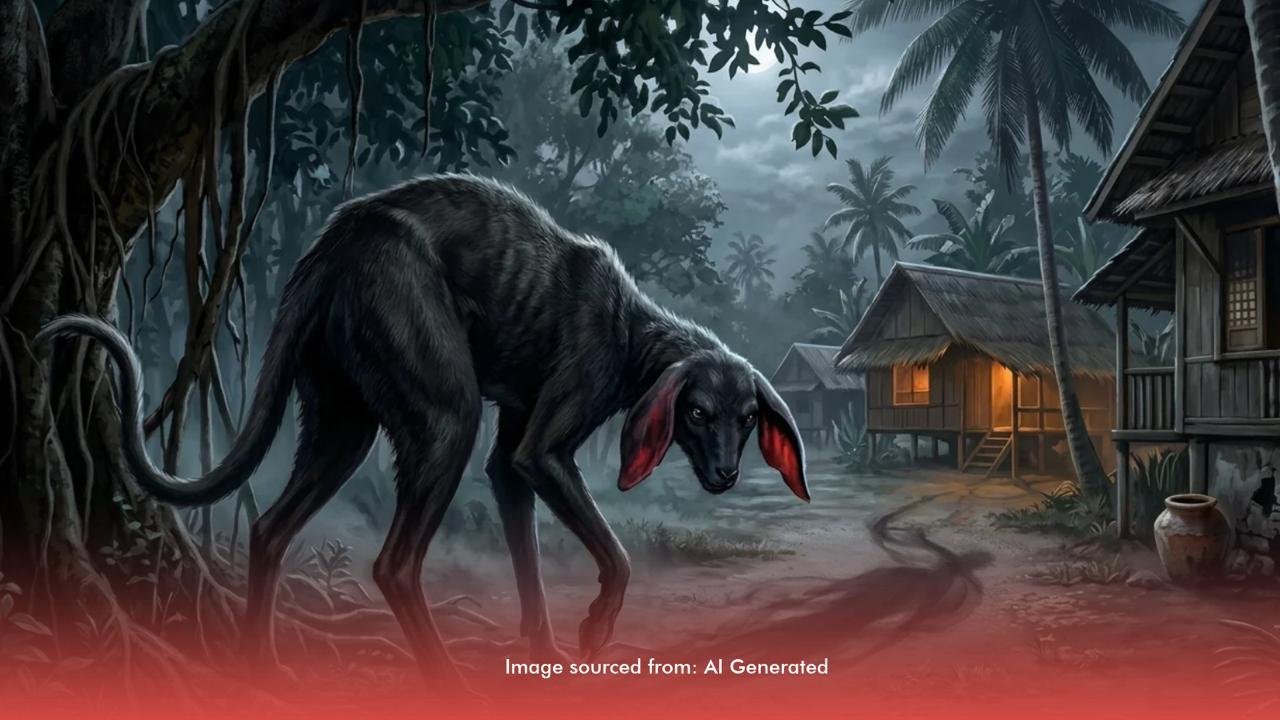
Some Visayan families, the story goes, inherit more than land, money and family heirlooms.
They inherit a creature.
John Wolff’s 1972 Dictionary of Cebuano Visayan describes the sigbin as an animal “possessed by and at the service of” a person. Invisible to everyone except its owner, it can supposedly carry its master from place to place and attack anyone it is commanded to harm.
And the frightening part? You may not be able to simply get rid of it.
When its owner dies, some traditions say the sigbin passes to a relative. Refuse to accept it, and madness may follow.
A Creature That Walks Backward
A sigbin, also spelled sigben, appears in Visayan and Mindanao folklore as a nocturnal creature kept and commanded by a person known as a sigbinan.
Its most disturbing feature is the way it moves.
The creature is said to walk backward, with its head lowered and turned between its hind legs. Its rear legs are supposedly longer than its front ones, giving it an unnatural, almost impossible silhouette in the darkness.
Descriptions vary wildly.
Folklorist Maximo Ramos described something resembling a hornless goat with enormous ears, a long flexible tail and a terrible smell. Other accounts describe a dog-like creature, a black animal with drooping ears, or something resembling a rabbit, bat or long-legged crow.
One particularly strange version describes a sigbin large enough to be ridden like a horse, with its head facing the rider.
There is no single appearance. That may be part of what makes the creature so difficult to picture.
The Beast That Drinks Shadows
The sigbin is not frightening simply because of how it looks.
According to some traditions, it feeds on the shadows of its victims.
Rather than leaving a visible wound, it is said to drink a person's shadow and cause illness or death. Other stories give the creature a taste for blood, charcoal or even human flesh.
José Buenconsejo recorded a belief that during Holy Week, the creature leaves its hiding place and wanders into villages searching for charcoal.
Herminia Meñez documented another darker tradition: sigbin are said to eat babies, particularly when they are not given blood.
And if you happen to catch one?
One story says you won't live long enough to celebrate.
The Family With a Monster in the Jar
Perhaps the creepiest sigbin stories are not about creatures wandering through forests.
They are about the ones supposedly hiding inside people's homes.
A sigbinan is a person or family believed to keep a sigbin. In some traditions, the creature is concealed inside a clay jar and secretly fed.
Edgar Calabia Samar's 101 Kagila-gilalas na Nilalang records a Capiznon belief that wealthy families feed their sigbin grated coconut, squash and charcoal.
That turns the sigbin from a simple monster into something more sinister: a secret explanation for a family's fortune.
A family suddenly becomes rich.
A neighbor's child becomes mysteriously ill.
Someone dies without an obvious explanation.
Whispers begin.
Maybe the family has a sigbin.
Folklore like this can explain things people cannot otherwise understand. But accusations could also have real consequences.
Ramos recorded a Bohol story about a dead man's brother who could not sell cassava in his town during Lent because people still believed the family carried a curse.
Where Does the Sigbin Lurk?
Sigbin stories are strongly associated with the Visayas, particularly Cebuano, Hiligaynon and Capiznon-speaking communities, as well as parts of Mindanao.
But the creature changes depending on where the story is told.
In some Hiligaynon traditions, for example, the sigbin is described as frog-like and capable of drinking the shadows of dying people.
Other versions emphasize its terrible smell, its ability to disappear or its connection to wealthy families.
Like many creatures in Philippine folklore, the sigbin does not come with one fixed description. It changes as the story travels.
Is the Sigbin Really a Kangaroo?
This is where folklore meets the internet.
Look at some descriptions of the sigbin: long hind legs, shorter front legs, large ears and a long tail.
Sounds familiar?
Some people have suggested that the sigbin may have been a kangaroo or wallaby seen by early Filipinos.
There is no zoological evidence supporting that theory. Kangaroos and wallabies are native to Australia and nearby regions, with no known native Philippine population or fossil record connecting them to the sigbin.
The resemblance may simply be coincidence.
Once an unfamiliar animal becomes familiar, people naturally use it to explain older stories. A creature with strange legs and a long tail can suddenly acquire a very familiar shape in the imagination.
Where Did the Story Begin?
No confirmed early written source tells us exactly when the sigbin legend began.
There are also claims online about Spanish-era writers documenting families who kept demons inside boxes, but these stories have not been clearly connected to an identified historical chronicle.
What is clearer is what the sigbin represents in folklore.
It gives shape to things people fear but cannot explain: unexplained illness, sudden death, strange sounds at night and wealth that seems to appear out of nowhere.
Samar's 101 Kagila-gilalas na Nilalang places the sigbin under halimaw, or beasts, rather than aswang. Despite their frequent association in popular stories, a sigbin does not necessarily have to be an aswang.
The Old Warnings
If you ever find yourself alone at night and hear something moving strangely behind you, old stories offer a few warnings.
Notice the smell. A sudden, terrible odor was sometimes said to signal that a sigbin was nearby.
Don't try to catch it. According to the folklore, the consequences could be fatal.
Be wary of the mysterious jar. Some traditions say the creature can be passed down through a family, whether the next heir wants it or not.
And perhaps the most important warning:
Don't turn folklore into an accusation.
Calling a person a sigbinan or aswang can cause real harm. A sick child needs medical care, not a monster to blame. A wealthy family may have secrets, but that does not make a creature in a jar one of them.
A Story That Refuses to Die
There is an eerie coincidence in Wolff's Dictionary of Cebuano Visayan.
The entry for sigbin appears near sigbaw, a Cebuano formula once used to supposedly protect oneself from lightning after mocking an animal, and sígi, meaning “go on” or “continue.”
For a creature believed to survive its owner and pass quietly from one generation to the next, the placement feels almost too fitting.
Because perhaps that is what the sigbin really does best.
It survives.
Not in a jar. Not in the shadows.
But in the stories people continue to tell when the night gets quiet and something strange moves just beyond the edge of the light.