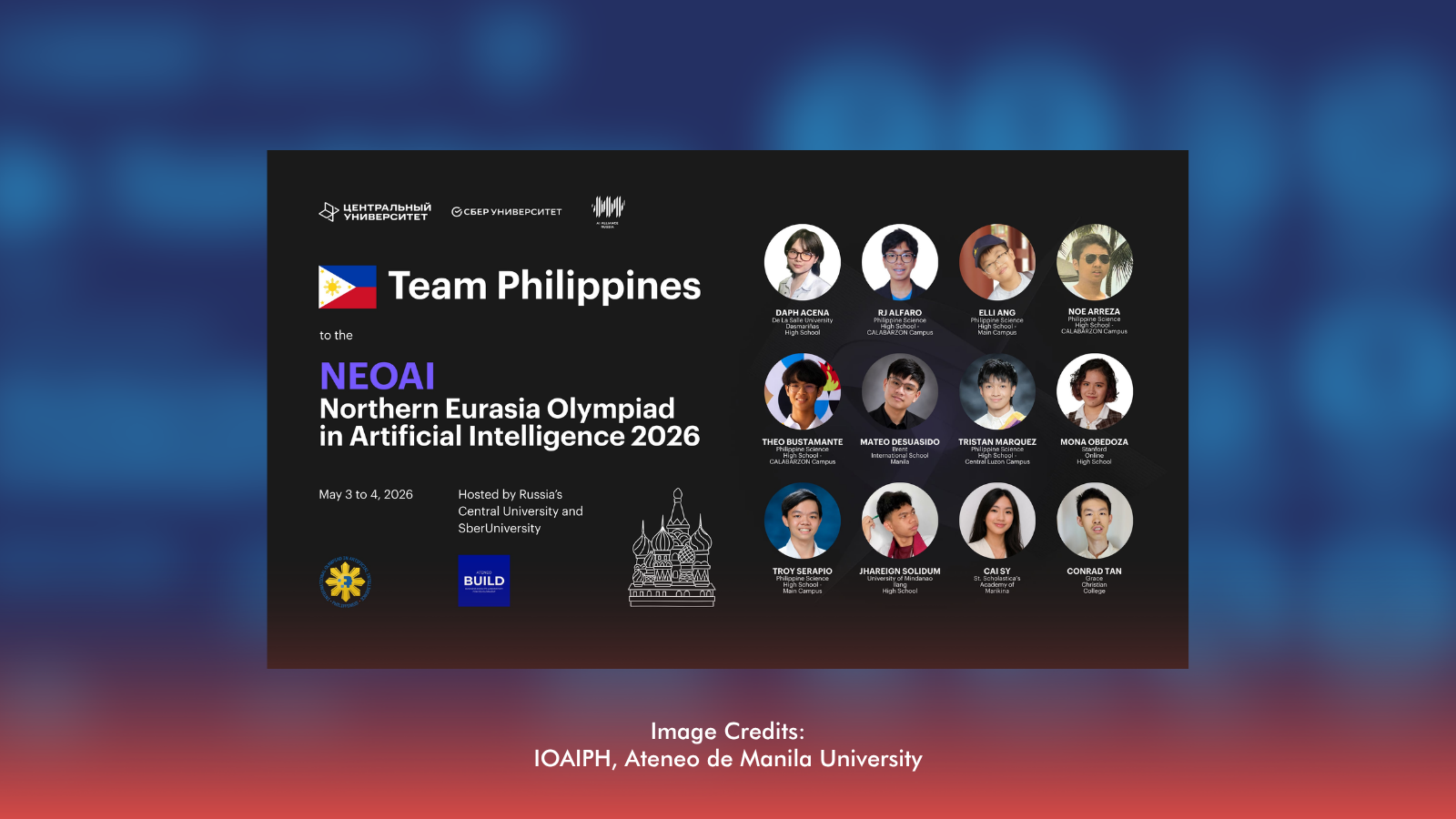
The Philippines earned a strong podium finish after placing third overall in the 2026 Northern Eurasia Olympiad in Artificial Intelligence (NEOAI), which ran from May 3 to 4, 2026.
The competition was conducted in a hybrid setup, allowing participants from various countries to either compete online or join through designated local testing centers organized in their respective nations. This format enabled wider international participation while maintaining a unified competitive structure.
The Philippine delegation went up against 224 young computer science contestants representing national teams and independent entries from countries such as Russia, Romania, Iran, Malaysia, Serbia, Cyprus, and Mongolia.
According to a statement from the International Olympiad in Artificial Intelligence Philippines, hosted by the Ateneo de Manila University Business Insights Laboratory for Development of the John Gokongwei School of Management, all 12 Filipino delegates successfully received official international certifications from Central University and the AI Alliance Russia after completing the demanding two-day contest organized by Central University and SberUniversity.
Strong Showing in Advanced AI Competition
Participants were assessed through advanced artificial intelligence tasks covering machine learning, computer vision, and audio processing, testing both theoretical knowledge and practical engineering skills. Leading the Philippine team was Juan Mateo Desuasido of Brent International School Manila, who secured 17th place globally with 365.79 points, placing him in the equivalent gold tier and making him the highest-ranked competitor outside the Russian and Romanian teams.
In the silver tier, Daphne Eunice Acena of De La Salle University-Dasmariñas High School and Theo Lorenzo Bustamante of Philippine Science High School–Calabarzon Region Campus placed 51st and 56th globally, respectively. Meanwhile, five other Filipino competitors earned bronze-tier equivalent rankings, including students from Philippine Science High School campuses and Grace Christian College. Another team member, Ellison Matthew Ang of Philippine Science High School, received an honorable mention after placing 110th worldwide.
National Ranking Reflects Growing AI Talent
The remaining representatives, Almond Rose Obedoza of Stanford Online High School, Jhareign Solidum of University of Mindanao Ilang High School, and Noe Nathan Arreza of Philippine Science High School–Calabarzon Region Campus, also obtained official certification for their participation and performance.
Based on the average scores of each country’s top three performers, the Philippines secured third place among all national delegations, trailing only Russia and Romania. The team received support from private sponsors and community partners, including Analytics and AI Association of the Philippines, Joy Nostalg, Times Paint, and the Tiu family. Organizers noted that the outcome reflects the strength of AI education in the country and the growing depth of Filipino talent in advanced technology fields.
The result highlights how Filipino students are increasingly competitive in global tech-driven fields, strengthening the country’s potential in artificial intelligence development, digital innovation, and future-ready industries that can contribute to national economic growth and job creation.