
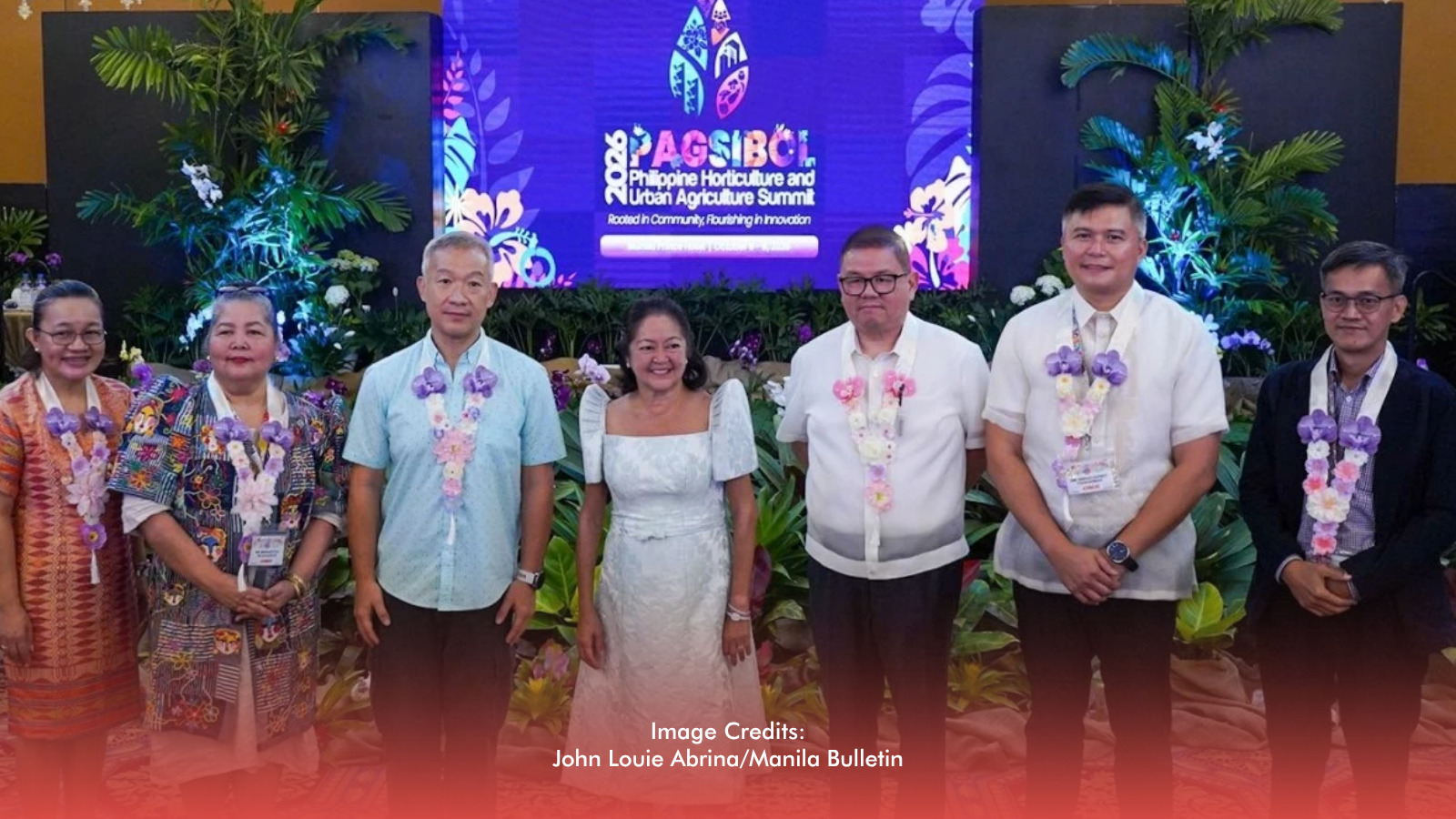
The future of Philippine agriculture depends not only on what farmers grow, but also on the science, production methods, and market decisions that determine whether crops can thrive. This was a central focus of Pagsibol 2026: Philippine Horticulture and Urban Agriculture Summit, which gathered farmers, researchers, policymakers, growers, and other agriculture stakeholders in Manila from October 6 to 8 for its third edition.
The summit brought together representatives from government, academe, and the private sector to examine how innovation can strengthen food production, support livelihoods, and conserve the country’s plant resources. Its discussions covered improved planting materials, high-value crops, precision agriculture, sustainable urban farming, pest management, and the protection of indigenous species, with an emphasis on turning research into practical solutions.
RELATED: [PH Launches 1st Seaweed Bioreactor to Support Farmers, Boost Exports]
Science and Market Demand Shape Better Production
During Session 4, Dominic A. Galimba, Plant Tissue Culture Consultant and Micropropagation Specialist, discussed how plant tissue culture and mutation breeding can improve the availability and quality of planting materials for high-value crops. He identified climate change, El Niño, emerging pests and diseases, and growing demand for quality planting materials as pressures that require agriculture to move beyond conventional methods.
“These challenges tell us that we cannot rely on conventional approaches alone. We need science and innovation to make agriculture more resilient, productive, and sustainable,” Galimba said.
Plant tissue culture allows selected planting materials to be multiplied rapidly and can help produce disease- or virus-free materials. Mutation breeding, meanwhile, generates genetic variation that researchers can evaluate for useful characteristics. Galimba emphasized that the process must go beyond producing variations, as researchers still need to screen and validate which traits offer practical benefits.
“The real advantage is faster deployment of valuable genetics,” he added.
The commercial side of production was another major topic. Dr. Nuttha Potapohn of Chiang Mai University examined the future of floriculture, including automation, precision cultivation, controlled environments, improved varieties, sustainable practices, and post-harvest handling. She cited a chrysanthemum project in Thailand that combined an evaporative house, drip irrigation, and fertigation, increasing yield by 8% to 10%, cutting chemical use by about half, and reducing watering time from 30 minutes to four minutes per house.
Potapohn argued that effective technology does not have to be complicated. “It is better to do something that's simple, but smart,” she said.
She also stressed that growers should identify potential buyers before deciding what to plant. “If you want to be successful in your production or your business, it is better to start with the market. What is your market demand? And then you go for it,” she explained. The approach highlights the importance of matching production decisions with actual demand, particularly as growers manage costs and changing consumer preferences.
Native Plants and New Frontiers in Horticulture
Protecting Philippine plant diversity formed another part of the summit’s program. Session 5 opened with Dr. Teresita D. Amore, associate researcher at the College of Tropical Agriculture and Human Resources of the University of Hawaii at Manoa, who discussed Anthurium breeding and genetics. On the third day, Dr. Lavernee S. Gueco of the National Plant Genetic Resources Laboratory explored the collection, conservation, and use of indigenous Philippine fruits and nuts, including their suitability for local conditions, potential applications, and cultural importance.
Marlo D. Mendoza, MDM, dean and associate professor of the College of Forestry and Natural Resources at the University of the Philippines Los Baños, focused on incorporating indigenous Philippine flora into urban landscaping. He identified rapid urbanization and habitat loss as threats to native plants, while pointing to pocket gardens, roadsides, parks, institutional grounds, and other open spaces as possible sites for conservation.
However, selecting native species requires more than simply choosing plants that originate in the Philippines. Mendoza said planners must assess each species’ mature size, root system, light requirements, crown, water availability, surrounding infrastructure, and ecological value. He also highlighted gaps in the availability of planting materials and research on indigenous and endemic species.
“When native flora becomes part of everyday urban landscapes, conservation becomes part of everyday life,” Mendoza said.
The program also explored how horticulture could support applications beyond farms and cities. Dr. Joel L. Cuello of the University of Arizona discussed vegetable production as bioregenerative life support, examining how crops might be selected for use in space. Other sessions addressed export-quality high-value vegetables, the nutraceutical potential of Philippine edible flowers, precision agriculture, Internet of Things (IoT)-driven microclimate control, artificial intelligence for pest and disease management, and scalable precision agriculture for Filipino growers.
Turning Research Into Practical Results
Agriculture Secretary Francisco P. Tiu Laurel Jr. underscored the importance of bringing agricultural ideas into real-world settings, from farmers’ fields and city rooftops to community gardens and commercial enterprises. This principle connected the summit’s different discussions, which examined not only what science can develop but also whether the resulting methods are affordable, workable, suited to their environments, and capable of meeting market needs.
The opening and ribbon-cutting ceremony was attended by Agricultural Training Institute Assistant Director Antonieta J. Arceo, Philippine Council for Agriculture and Fisheries Executive Director Bernadette B. Delos Santos, Manila Bulletin President Dr. Emilio C. Yap III, First Lady Louise Araneta-Marcos, Agriculture Secretary Francisco P. Tiu Laurel Jr., Bureau of Plant Industry (BPI) and National Urban and Peri-Urban Agriculture Program (NUPAP) Director Dr. Gerald Glenn F. Panganiban, and Bukid Amara owner Michael Caballes.
Pagsibol 2026 placed the practical value of agricultural innovation at the center of its discussions, connecting research with production, conservation, and business decisions. For the Philippines, where food supply, farm incomes, and access to affordable produce affect households nationwide, advances in horticulture matter most when they help growers produce reliably, reduce avoidable costs, protect valuable plant resources, and bring viable agricultural opportunities to more communities.
RELATED: [DA Commits P1.19-B for Farm-to-Market Roads in Isabela]