A group of Filipino students from Rizal Technological University (RTU) achieved a major milestone after their science experiment was successfully conducted aboard the International Space Station (ISS) by a National Aeronautics and Space Administration (NASA) astronaut. The project formed part of the 2025 Asian Try Zero-G (ATZG 2025) competition, which gives students across Asia the opportunity to design experiments for microgravity conditions.
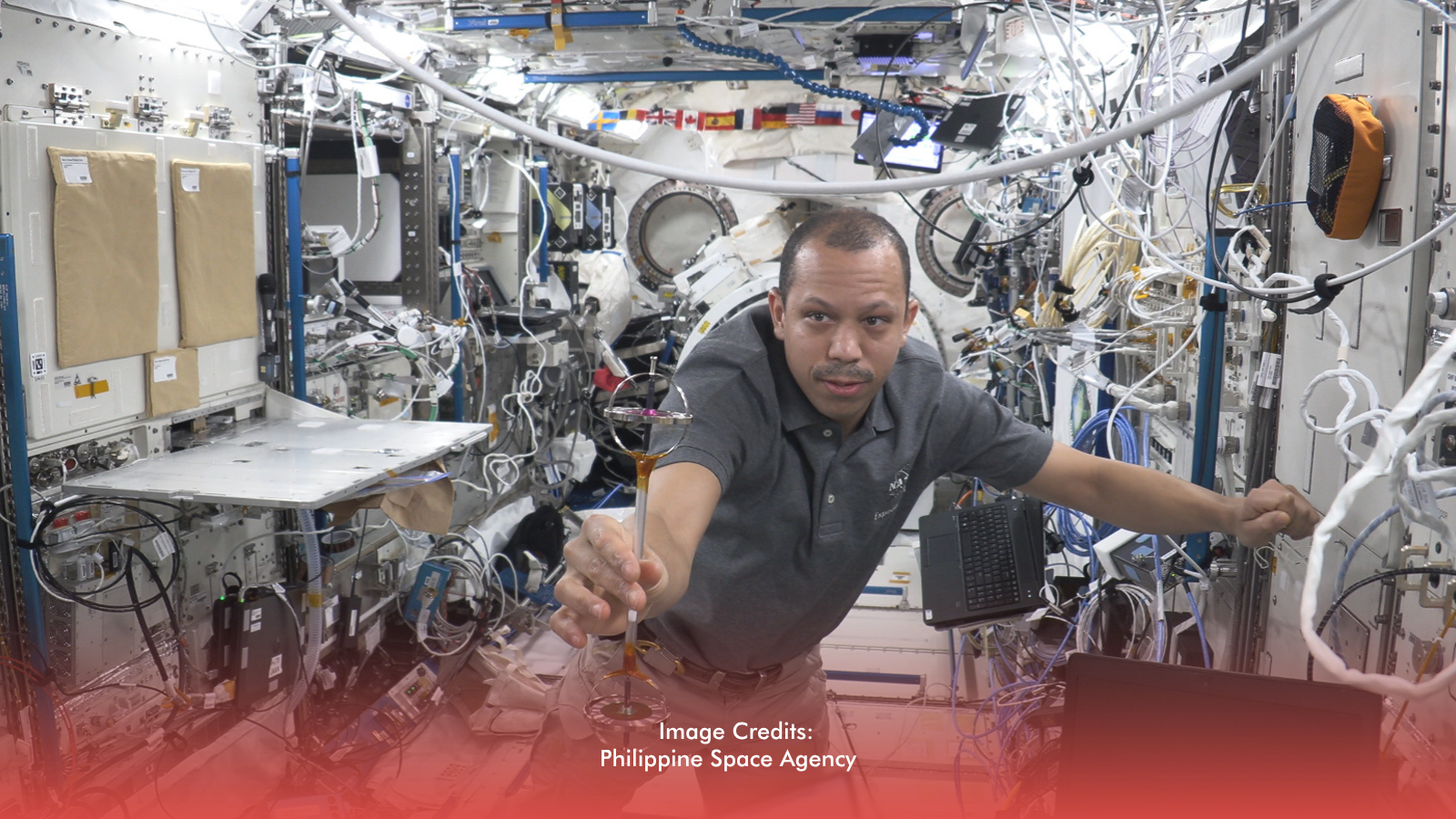
According to the Philippine Space Agency (PhilSA), the experiment called “Double Gyroscope” was carried out by astronaut Christopher Williams inside the Kibo module of the ISS on March 24, 2026. The activity marked another achievement for Filipino students participating in international space science programs.
The experiment was developed by third-year RTU students Christopher Tumamac, Ryan Andrew Doña, and Rose Ann Cezar. Their project explored how two spinning gyroscopes positioned on opposite ends of a stick behave in a microgravity environment and how such movement could affect stability and directional control in spacecraft systems.
RELATED: [Muntinlupa Becomes Home To NCR’s First DOST Innovation Hub]
Filipino Students Explore Spacecraft Orientation in Microgravity
Gyroscopes are devices used to help maintain balance and orientation, making them important components in satellites and spacecraft navigation systems. Through the Double Gyroscope experiment, the students aimed to demonstrate how rotational dynamics may influence stability in space conditions.
The project is considered significant because it simulates how spacecraft maintain orientation while operating in orbit. During the activity aboard the ISS, Williams performed several tests under microgravity conditions to observe how the system behaved.
Results of the experiment are expected to be presented during the ATZG 2025 wrap-up session later this year. The Filipino team’s proposal was among 11 finalists selected from participating countries including Australia, Bangladesh, Japan, Malaysia, Singapore, Taiwan, Thailand, and the United Arab Emirates.
Philippine Participation Gains International Recognition
The experiments were conducted live aboard the ISS and streamed to finalists gathered at the Japan Aerospace Exploration Agency (JAXA) Tsukuba Space Center in Ibaraki, Japan. Prior to the experiment, Doña and Tumamac presented their proposal at the facility, where the final outcomes reportedly aligned with the students’ original hypotheses.
PhilSA facilitated the Philippines’ participation in the competition and has continued supporting Filipino students entering international space science initiatives.
“We are very thankful for this opportunity given to us by PhilSA, and we hope more Filipino students will apply in the next batches of ATZG to experience proposing experiments in zero gravity and seeing them carried out,” the team said.
PhilSA also highlighted the growing presence of Filipino students in the competition.
“Since 2022, experiments from Filipino students have consistently been selected as ATZG finalists and carried out on the ISS by astronauts,” the agency said.
For many Filipinos, achievements like this showcase the country’s growing potential in science, technology, and space research. It also inspires younger students to pursue careers in engineering and innovation while proving that Filipino talent can compete and contribute to global scientific advancements.
RELATED: [UP Researchers Turn To AI To Combat Bacterial Infections]