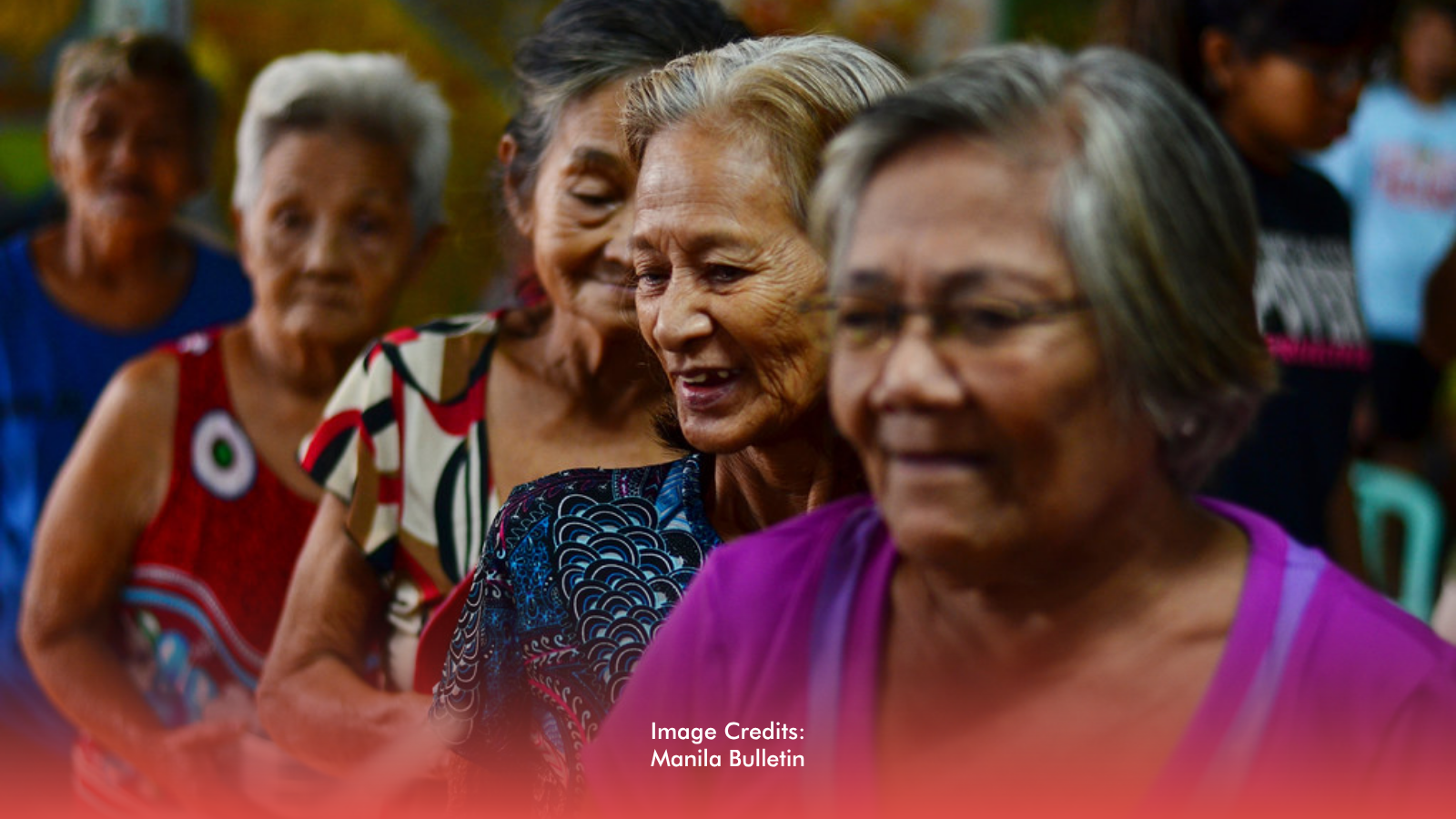
A large share of Filipino senior citizens may be financially vulnerable even when they are not officially classified as poor, according to research presented at a recent social protection policy forum. The findings indicate that economic insecurity among older Filipinos extends well beyond what the country’s official poverty figures capture.
Data from a study on household vulnerability to income poverty showed that 7.8 percent of senior citizens were classified as poor in 2023, while 24 percent were vulnerable to falling into poverty. The research was presented during the Inclusive Social Protection Services in the Philippines’ Policy and Research Forum organized by the Philippine Institute for Development Studies (PIDS) and Australia’s Social Protection, Inclusion, and Gender Equality program (Spring).
RELATED: [Industry Group Calls for More Jobs, Investment After Poverty Falls to 9.7%]
Poverty Figures May Not Show Full Risk
According to PIDS Supervising Research Specialist Deanne Lorraine Cabalfin, the standard poverty measure focuses on households that are already below the established threshold. It does not fully reflect the situation of families who remain above that line but could quickly fall below it following events such as illness, income loss or other financial shocks.
The official poverty threshold measures whether a household can meet basic food and non-food requirements at a particular point in time. For older Filipinos, however, fixed or limited incomes combined with increasing medical expenses can leave little room to absorb unexpected costs.
"For older Filipinos, whose incomes are often fixed and whose health care needs tend to increase with age, vulnerability can provide a more comprehensive picture of economic insecurity than poverty status alone," Cabalfin said.
The risks are even more pronounced for certain groups. The study found that vulnerability reached nearly 45 percent among seniors living in mixed-generation households with children, despite relatively low poverty rates among those households.
Living arrangements and gender also influence financial security. Older women living alone tend to rely heavily on remittances, while older men living alone were found to have the fewest assets. Across older households, food and health care account for a larger portion of income, leaving less money available when emergencies arise.
Pension Gaps Add to Senior Financial Insecurity
Pension coverage remains another concern. Spring Program Social Protection Specialist Aura Sevilla said 42 percent of Filipinos aged 60 and above have no pension. Among SSS members who receive pensions, nearly one-third get less than P3,000 a month.
The government’s social pension for indigent seniors provides P1,000 monthly, but the program continues to experience targeting issues, with some qualified seniors excluded while some non-indigent beneficiaries are included.
Cabalfin called for vulnerability to be considered alongside conventional poverty measurements when determining who needs assistance.
"We need to regularly measure vulnerability alongside poverty so that the program targeting reflects the real risks people face," she said.
She also recommended a fiscally sustainable expansion of social pensions and the institutionalization of vulnerability assessments alongside poverty statistics. Australian Embassy Second Secretary Claire Bowyer emphasized the need for social protection systems to respond more effectively to changing circumstances.
“The question is no longer whether social protection matters. The question is how we can make it more responsive, more inclusive, and better equipped to support people through change and uncertainty,” Bowyer said.
PIDS President Philip Arnold Tuaño likewise stressed that research should translate into improvements in people's lives.
“Research achieves its greatest value when it improves people’s lives,” Tuaño said.
The Department of Economy, Planning, and Development cited reforms such as the Social Protection Operational Framework, the Social Protection Floor, digital payments for 4Ps beneficiaries and the national ID rollout. These measures are intended to make social protection programs more integrated and accessible, although implementation challenges remain.
Australia has partnered with the Philippines on social protection for more than 20 years, while Spring is a five-year bilateral program supporting stronger social protection policies and systems, gender-responsive budgeting and planning, and improved data for reaching vulnerable groups, including persons with disabilities and Indigenous peoples.
For Filipino families, the findings show why senior welfare cannot be measured by poverty statistics alone. A parent or grandparent who is above the poverty line today can still face serious hardship after a medical emergency, loss of income or other unexpected expense, making stronger pensions and better-targeted assistance important to household stability and the country’s broader social protection system.
RELATED: [8.8 Million Filipinos Lifted Out of Poverty in 2025, DEPDev Reports]